

Companies recognized as customer experience leaders have generated a cumulative shareholder return 7.8 times greater than customer experience laggards over the past 18 years, according to Watermark Consulting’s long-running CX ROI Study. This is proof that treating CX like capital, not an expense, pays off in the language every executive already speaks. Fixing a broken customer experience doesn’t start with new technology.
It starts with investment discipline: a connected operating model, shared ownership, and a rhythm that makes CX gains compound over time. Then it requires seven shifts to take you from broken to orchestrated, which we will share with you.
In part one of this series, I walked through why customer experiences keep failing and why the root cause is almost always an operating model that wasn’t built around the customer. Now in part two of this series, we will cover what to do about it:
- the operating-model shifts,
- governance conditions,
- and investment discipline that turn a broken customer experience program where ROI compounds.
Treat CX Investment Like Capital
Customer Experience should be governed less like a series of departmental expenses and more like a portfolio of customer-facing capital that’s owned, measured, reviewed, and reinvested based on return. A finance team treats capital as something that’s governed, carries a return expectation, and compounds when it’s deployed well. CX investment rarely gets treated that way. It tends to get allocated by department, measured in pieces, and reviewed inconsistently.
Applying that same discipline to CX means setting a clear return expectation, giving someone the authority to hold decisions to it, and measuring the return across the whole journey rather than in channel-level pieces. This is where customer experience ROI is won or lost. CX ROI shows up when journey improvements reduce operational drag, lower cost to serve, improve conversion or retention, and help customer experience investments compound instead of stall.
The organizations that connect the operating model for good don’t do it by adding more touchpoints or buying more tools. They bring investment discipline to their CX work, and the returns start compounding.
This is the logic behind the BlastX CX Capital System™: a repeatable operating motion for diagnosing where value is leaking, reallocating effort toward the highest-impact opportunities, refining the systems and technology that support the journey, activating what works, and compounding returns over time. The shifts that follow are the operating-model requirements that make that system work in practice.
An expense mindset asks what launched. An investment mindset asks what returned. That one question changes the roadmap, the budget conversation, and what gets worked on next.

Seven Shifts That Make CX Investment Compound
Customers aren’t trying to complete a channel interaction. They are trying to accomplish a goal, and CX strategy has to be organized around that goal, rather than around internal departments. Across the engagements I’ve been part of where improvement has held, the work tends to move through seven shifts. These aren’t sequential steps. They reinforce each other, and together they make the CX Capital System™ work in practice.
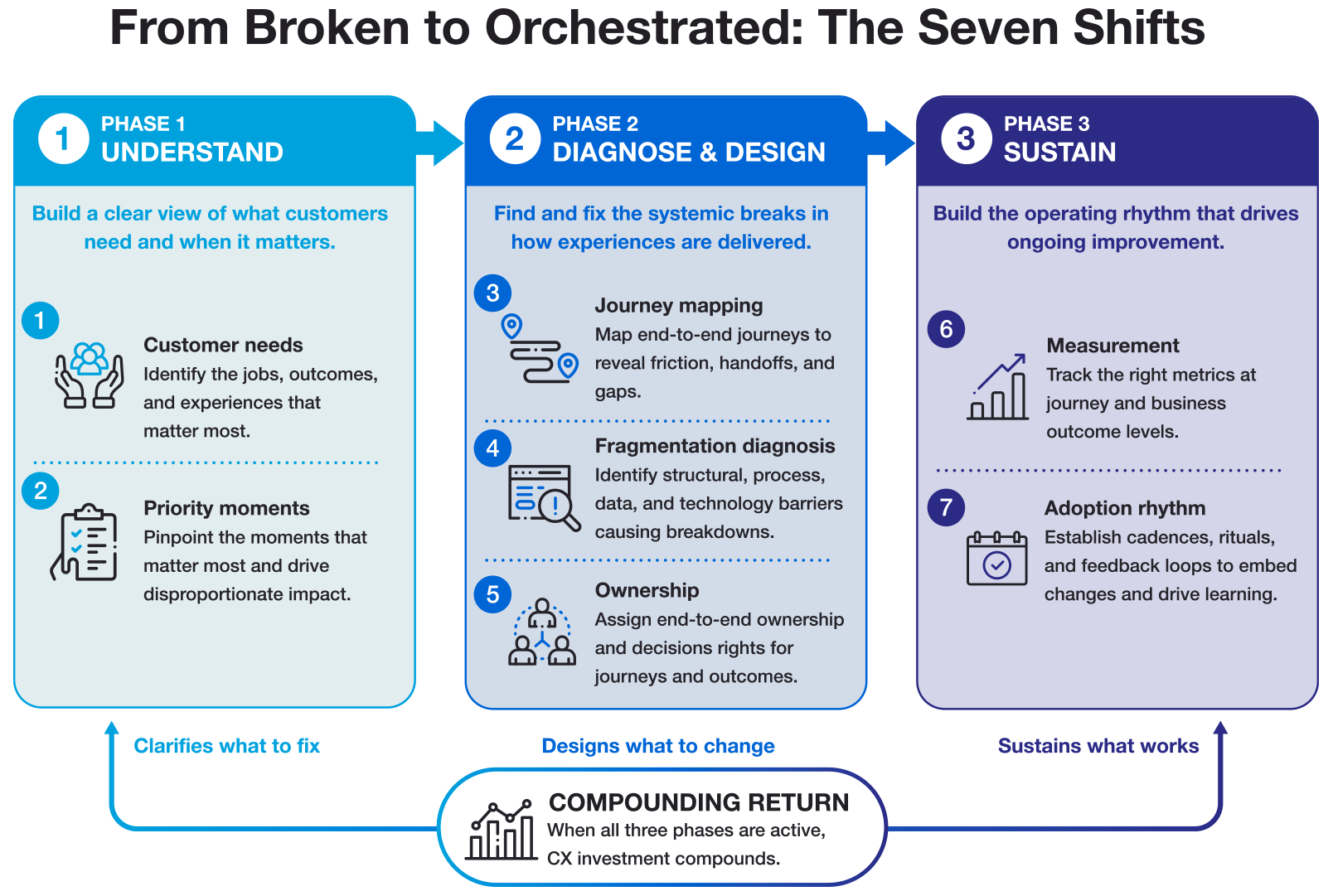
- Start with customer needs, not internal process flows. Identify the jobs customers are trying to get done, and separate customer intent from internal assumptions about how the journey should work.
- Identify the moments that matter most. Focus on the moments with the highest emotional, operational, or commercial impact: the ones most likely to drive conversion, trust, effort, and loyalty.
- Map the journey across front stage, backstage, and supporting processes. Look beyond visible touchpoints to the internal actions, dependencies, technologies, and policies that shape what customers experience. A service blueprint approach reveals the full picture, and that’s usually where the gaps are.
- Diagnose where fragmentation actually occurs. Name the specific breakdowns before designing the response, whether they sit between channels, teams, departments, policy and delivery, or customer expectation and operational reality. Naming the gaps is what makes the work actionable, and it’s almost always where the highest-return opportunities are hiding.
- Assign ownership for the journey, not just the touchpoints. Build a clear RACI for who owns metrics, who owns platforms, who approves changes, and how decisions get made when teams disagree. Governance has to support cross-functional action rather than just cross-functional discussion.
- Measure the experience the way customers live it. Move beyond isolated channel KPIs and define success across three tiers: touchpoint metrics such as customer effort and task completion, journey metrics such as end-to-end completion and handoff drop-off, and enterprise metrics such as cost to serve, retention, and customer lifetime value. The tiers only work if the definitions are locked first, agreed across marketing, sales, and service before anyone builds a dashboard. Shared KPI definitions are a governance decision, not a documentation exercise.
- Build the adoption rhythm to sustain improvement. Treat improvement as an ongoing operating discipline rather than a one-time project. Structured communication, training, reinforcement, and adoption checkpoints are what keep the gains from drifting and what turn a well-designed journey into a compounding asset.
Three Conditions That Make CX Improvements Stick
A framework for connecting the operating model only works if three conditions are in place. Without them, the improvement stalls or reverses.
A real owner. Someone is accountable for the end-to-end experience across functions, with the authority to make decisions when teams disagree. It can’t be a committee without authority or a rotating responsibility. It requires one accountable owner with a mandate, supported by a governance rhythm that reaches the table where budgets and priorities are set.
Shared definitions. Teams measure the same things the same way, so the data tells one story instead of five. When a lead means the same thing to marketing and sales, and a conversion counts consistently across every dashboard, the organization can manage the experience as one connected whole and see where it’s breaking before customers do.
A working rhythm. Improvements are reviewed, adjusted, and reinforced on a cadence rather than completed and handed off. The organizations that sustain CX progress treat it the way a finance team treats a portfolio, with regular reviews, return expectations, and a clear view of where to reinvest.
When these conditions are in place, technology starts enabling continuity instead of mirroring the silos, and MarTech stops acting like an underused investment and starts compounding.

What a Connected Operating Model Makes Possible
A broken customer experience isn’t a sign that companies aren’t trying. It’s a sign that the experience is being managed in pieces, by teams doing their individual jobs with no one accountable for the whole.
The path forward isn’t more channels or more tools. It is customer journey orchestration: the operating discipline of aligning ownership, data, decision rights, and measurement around the customer’s goal.
A broken customer experience isn’t the root problem. It’s the signal that the operating model behind the experience wasn’t built around the customer.
The goal isn’t to fund another CX initiative. It is to stop funding the broken playbook and start compounding the return.
Are Your CX Efforts Leaking Value?
Would you like to find out? If so, we provide a complimentary CX ROI Diagnostic to identify where value is leaking, and surface high-impact opportunities you can act on. No commitment, just clarity on where CX investment is stalling and where the return is likely to come from.
If you’d like to take advantage of it, you can learn more and request your CX ROI Diagnostic.
Frequently Asked Questions
What’s the difference between fixing a touchpoint and fixing the operating model?
Touchpoint fixes improve individual interactions such as a form, a call flow, or an email. Fixing the operating model requires addressing what happens between those touchpoints, including the handoffs, the data continuity, the ownership gaps, and the measurement misalignment across teams. Organizations that only fix touchpoints often see marginal improvements, because the breaks that go unnoticed are usually in the spaces between interactions rather than within them.
How do you measure a broken customer experience?
Measurement happens at three levels. Touchpoint metrics include conversion rate, customer effort, and satisfaction per interaction. Journey metrics include task completion across channels, drop-off at handoffs, and repeat contact rate. Business outcomes include cost to serve, retention rate, and revenue attribution. The key is shared definitions across teams, because when marketing, sales, and service count the same things the same way, the data reveals where the experience is actually breaking.
What operating model changes fix a broken customer experience?
The operating model changes that most often improve a broken customer experience are clear end-to-end ownership, shared KPI definitions, governance with authority, and a recurring cadence for reviewing journey performance and reinforcing improvements. Without these, design and technology changes produce short-term lifts that erode over time.