

Tealium iQ is one of the most flexible tag management systems on the market. It handles client-side tagging, abstracts away tedious implementation work, and still leaves room for custom code when teams need it. That flexibility is exactly why so many organizations choose it.
It is also exactly why things start to break.
The problem is not Tealium iQ itself. The problem is data governance: specifically, version control, once a team’s tagging workload grows past one or two people working on one thing at a time.
What Tealium iQ Handles Well
Tealium iQ sits inside the broader Tealium customer data platform (CDP) ecosystem. On the front end, it manages tag publishing through a familiar structure: Development, QA, and Production environments, the same pattern used across most software engineering workflows.
For a single specialist managing a light workload, this setup works fine. One tagging update moves through Dev, gets validated in QA, and ships to Production. There is nothing to govern because there is nothing to collide with.
Where Governance Starts to Break Down
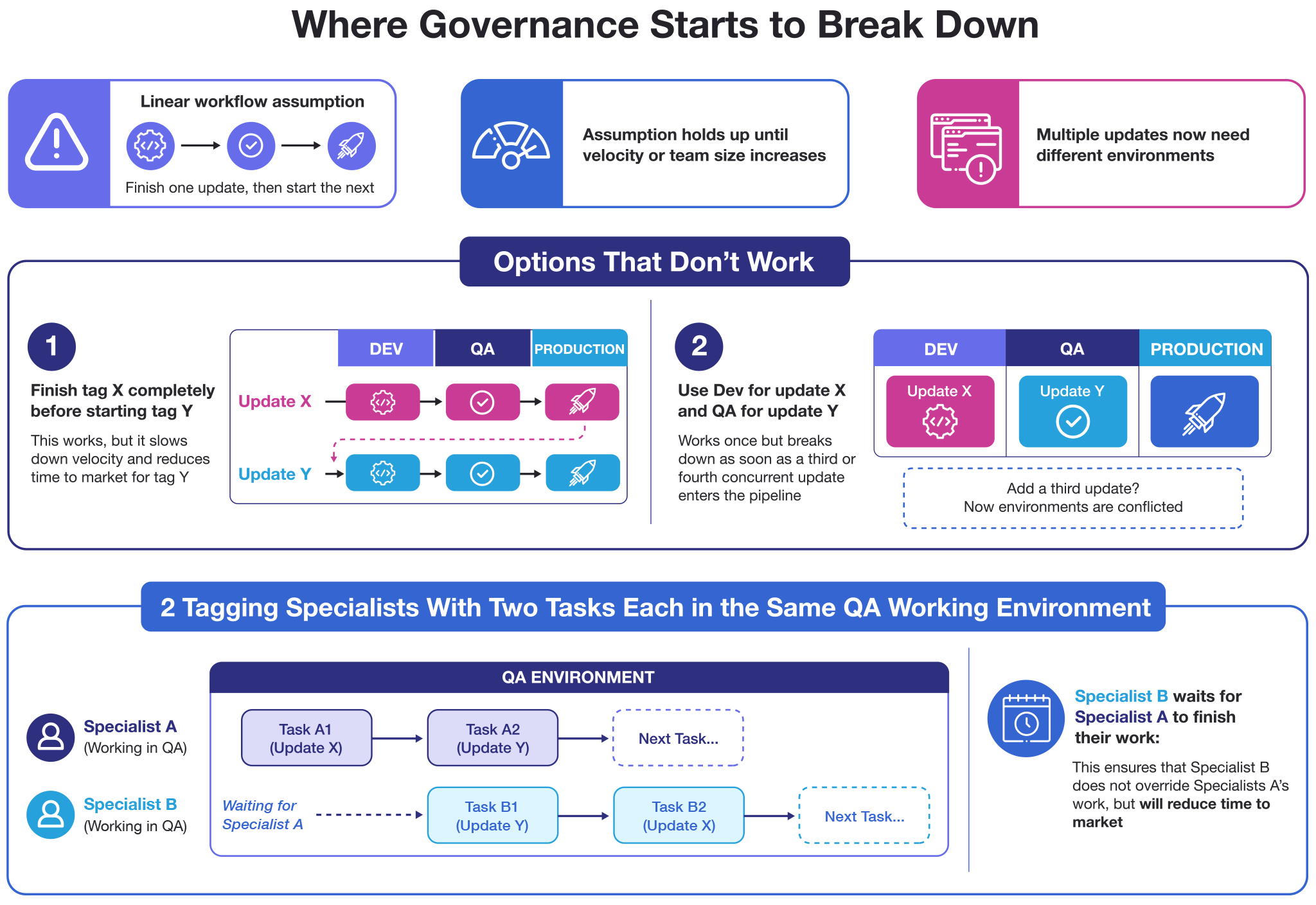
The default Dev, QA, and Production structure mirrors standard software environments at a high level. But it assumes a linear workflow: finish one update, then start the next.
That assumption holds up until velocity or team size increases.
Consider a tagging specialist managing two updates at once. Tag update X needs to go to production now. Tag update Y still needs to stay in a lower environment for testing. Here are some tempting options that won’t work:
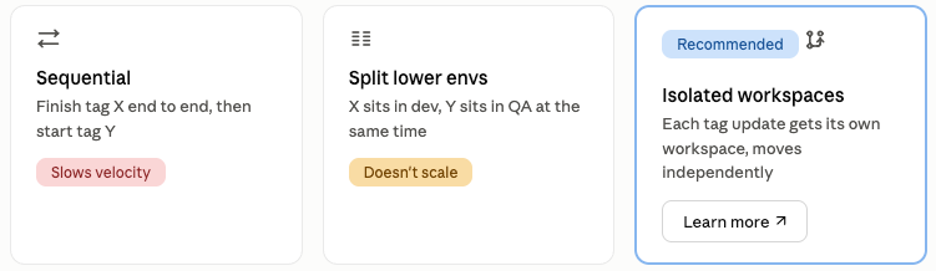
- Finish tag X completely before starting tag Y. This works, but it slows down velocity and reduces time to market for tag Y.
- Use Dev for update X and QA for update Y. This works once but breaks down as soon as a third or fourth concurrent update enters the pipeline.
Now consider 2 tagging specialists, each with two tasks, both working in the QA environment.
- Specialist B waits for Specialist A to finish their work: This ensures that Specialist B does not override Specialist A’s work, but will ultimately reduce time to market.
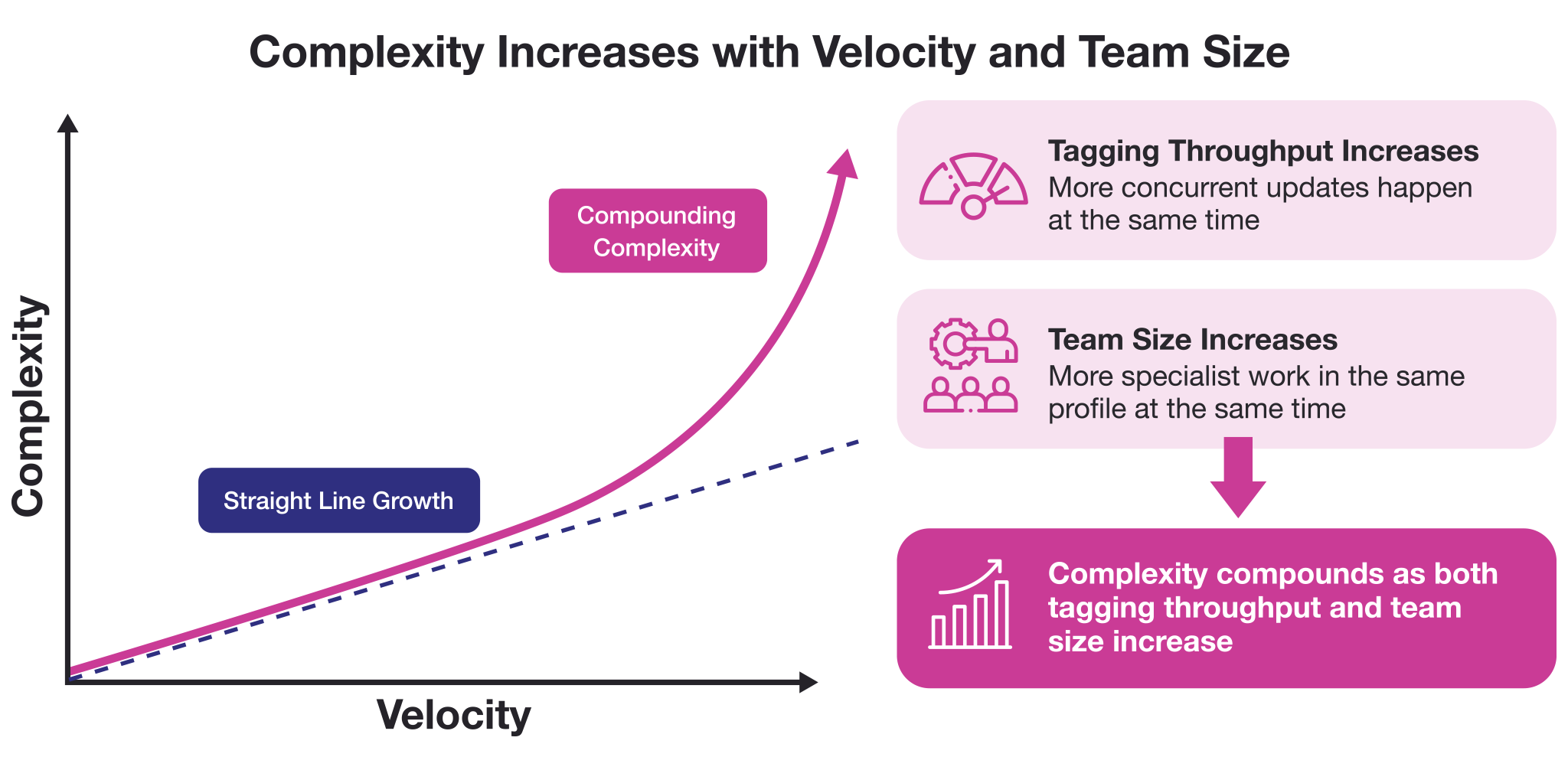
This type of complexity does not grow in a straight line. It compounds as tagging throughput increases (more concurrent updates) and as team size increases (more specialists working in the same profile at once).
Data governance at this level is essential, especially as you scale.
Why Tealium iQ Updates Need Governance
Most organizations run lean on tagging specialists, often just one or two people. When a workload is that small, an informal workflow feels sufficient. The trouble starts when those same specialists join or lead a larger team and keep the solo mindset that worked fine before.
The result is a predictable set of unintended consequences:
- Overriding work another specialist already completed.
- Pushing an update to production before it was meant to ship.
- Reloading QA back to a previous branch and losing in-progress work.
These are the same problems software engineering teams solved years ago with version control systems like GitHub. Tealium iQ has a “merge version” capability that can emulate some of that discipline, but without a governance model wrapped around it, the same chaos shows up in tagging that version control was built to prevent. This is especially true when teams rely on the “Publish” feature and do not leverage the “Merge” feature.
A governance model for high-velocity, highly managed teams needs to deliver four things:
- High velocity: multiple concurrent streams of work inside Tealium iQ.
- Organizational data safety: multiple specialists working without overriding each other’s work.
- Specific issue of rollbacks: the ability to undo one change without undoing everything.
- Precise control in production releases: precision over exactly what ships and when.
This is not a new discipline. It is a software engineering practice, adapted to how Tealium iQ actually publishes.
A Data Governance Model Built for High-Velocity Teams
The fix starts with reframing what the default environments are for.
Production Stays Production
Nothing changes here. Production remains the live, customer-facing environment.
Dev and QA Become the Staging Environment
Instead of treating Dev and QA as active workspaces, treat them as staging: where production-ready changes live before release. Small, high-confidence edits can still happen here directly, but most work should not originate in this layer.
Custom Environments Become Individual Workspaces
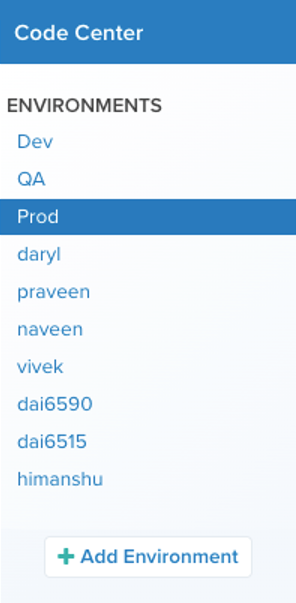
Tealium iQ supports custom environments inside a profile. Use these as the primary workspace for active work, scoped as needed: one version per ticket, or one environment per specialist. Think of each custom environment as an isolated local playground for a single workstream.
The Merge-Back Workflow
Once a workstream is validated in its own environment, merge it back into the shared Dev and QA staging branch. From there, it publishes to Production. Multiple specialists can move through this cycle independently, without touching each other’s work in progress.
This model improves customer experience quality in two ways: it protects data standards and protects time to market.
Avoiding the Most Common Merge Failure
Tealium iQ will sometimes refuse to merge a version into the Dev and QA staging branch. This almost always means the two versions do not share the same root base version.
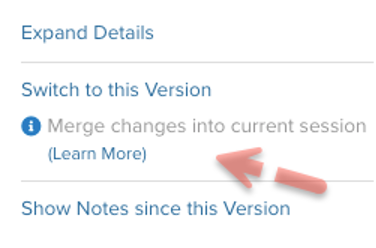
The short-term technical fix is to merge the most recent DEV/QA environment into your custom environment.
The long-term procedural solution is different: before starting any new ticket, pull the most recent Dev and QA staging version into your local environment first. That single habit keeps every workstream on the same branch of origin as the main staging branch and prevents merging conflicts before they happen.
The Benefits of Applying Governance to Tealium iQ Versioning
None of this is really about the process for its own sake. Once specialists have their own workspace and a clear path back to production, the impact shows up in three places.
Operational Impact: Publishing gets predictable again. Specialists aren’t second-guessing whether someone else touched their version, and when something does need to be undone, you roll back the one change that broke, not the whole environment.
Experiential Impact: You get fewer production incidents where an update ships before it’s ready. Tag data stays accurate, and since that data feeds the actual customer-facing experience, the experience stays accurate too.
Business Impact: Fewer emergency fixes mean fewer hours spent firefighting instead of building. Clean, trustworthy tag data also means the attribution and spend numbers marketing leans on for budget decisions hold up, instead of being padded by errors nobody caught.
Tealium iQ was never really a problem. It’s a genuinely capable tool that’s underutilized without the right operating model, and the difference between managing it and governing it shows up in all three of these areas at once. It’s also just one example. Most MarTech stacks have a few of these gaps, with tools that are fully capable but not set up to deliver their full value.
If you want to talk through where else that might be true for your MarTech stack, reach out and let me know. Even better, get yourself a CX ROI Diagnostic. We’ll analyze your customer-facing experience and the stack behind it, then walk you through it in a focused 30-minute session, typically within 2 weeks. Request your complimentary CX ROI Diagnostic here.
Frequently Asked Questions
What is data governance in Tealium iQ?
Data governance in Tealium iQ means having a defined process for how tag updates move between versions and environments, so multiple specialists can work concurrently without overriding each other’s changes or publishing unfinished work to production.
Why do the default Dev, QA, and Production environments break down at scale?
The default setup assumes a linear workflow: one update finishes before the next starts. Once a team runs multiple concurrent updates or adds more specialists, that assumption fails, and updates start colliding.
What is the custom version of Tealium iQ used for?
A custom version acts as an isolated workspace for a single ticket or specialist. Work happens there first, gets validated, and then merges back into the shared Dev and QA staging branch before publishing to production.
Why does Tealium iQ sometimes refuse to merge a version?
A merge fails when the two versions do not share the same root base version. Pulling the latest staging version into your local version before starting new work prevents this.
How does better Tealium governance affect customer experience?
It reduces production incidents caused by premature or overridden tag updates, which keeps the data feeding customer-facing experiences accurate, and it shortens time to market for validated changes.