

When customer experience is treated like a departmental expense, teams can do the right work and still deliver fragmented experiences. In this first of two articles, I’ll explain why that keeps happening and what the operating model behind it actually looks like. Part two covers the seven shifts that fix it for good.
When customer experience works, the investment compounds. Customers move through the journey with less friction and more confidence, teams operate with clarity, and data supports decisions instead of debates. CX spend starts showing up operationally, experientially, and on the P&L.
For many organizations, the effort and the investment aren’t translating into the experience customers receive. The issue is rarely effort. Teams are following the CX playbook they were handed: buy the tools, hire the teams, optimize the channels, add the next platform, and assume the customer experience will come together. It doesn’t. That CX playbook rewards activity instead of return, starts with technology instead of outcomes, and leaves the operating model behind the experience — disconnected from the customer.
A broken customer experience is usually a symptom of something deeper: an operating model that wasn’t built around the customer. By operating model, we mean the cross-functional system of ownership, decision rights, shared definitions, governance, measurement, and adoption rhythm that turns CX strategy into consistent execution. Connect that system, and the customer experience starts to work the way the business intended.
The shift starts when leaders stop treating CX as a departmental expense and start treating it as customer-facing capital. An expense mindset asks what launched. An investment mindset asks what returned. That single question changes the roadmap, the budget conversation, the governance model, and the way teams decide what to address next.
When we say the experience is broken, we don’t mean customers or teams are failing. We mean the customer experience is fragmented because the operating model behind it isn’t connected enough to deliver what the business intends. Forrester’s 2025 Customer Experience Index found that only 7 percent of US brands improved from 2024 to 2025, and globally, 73 percent of brands remained statistically unchanged. The effort is there. The investment is there. The experience has stalled.
A broken customer experience is rarely a people problem. It’s a process problem, and the highest-return fixes are almost always hiding in the handoffs nobody owns.

Why the Broken CX Playbook Fails
Technology matters, but technology isn’t a CX strategy. The vendor-driven playbook starts with platforms, roadmaps, licenses, and features. A capital-investment mindset starts somewhere different: with the business outcome, the customer behavior that needs to change, and the operating model required to make that change repeatable.
AI doesn’t change this. It amplifies whatever foundation already exists. On a connected operating model, AI can accelerate decisions, personalize interactions, and improve activation. On a fragmented one, AI simply automates the same disconnected motions faster. The data, definitions, handoffs, and governance underneath have to be sound first.
The Real Cost of a Broken Customer Experience
A broken customer experience doesn’t show up as a single visible event. It accumulates quietly across hundreds of interactions, in the spaces between teams where no one is clearly accountable. The challenge for leaders is that these costs rarely appear in the same place, which makes the full business impact easy to underestimate. The cost lands on three levels, and most organizations are only seeing part of it.
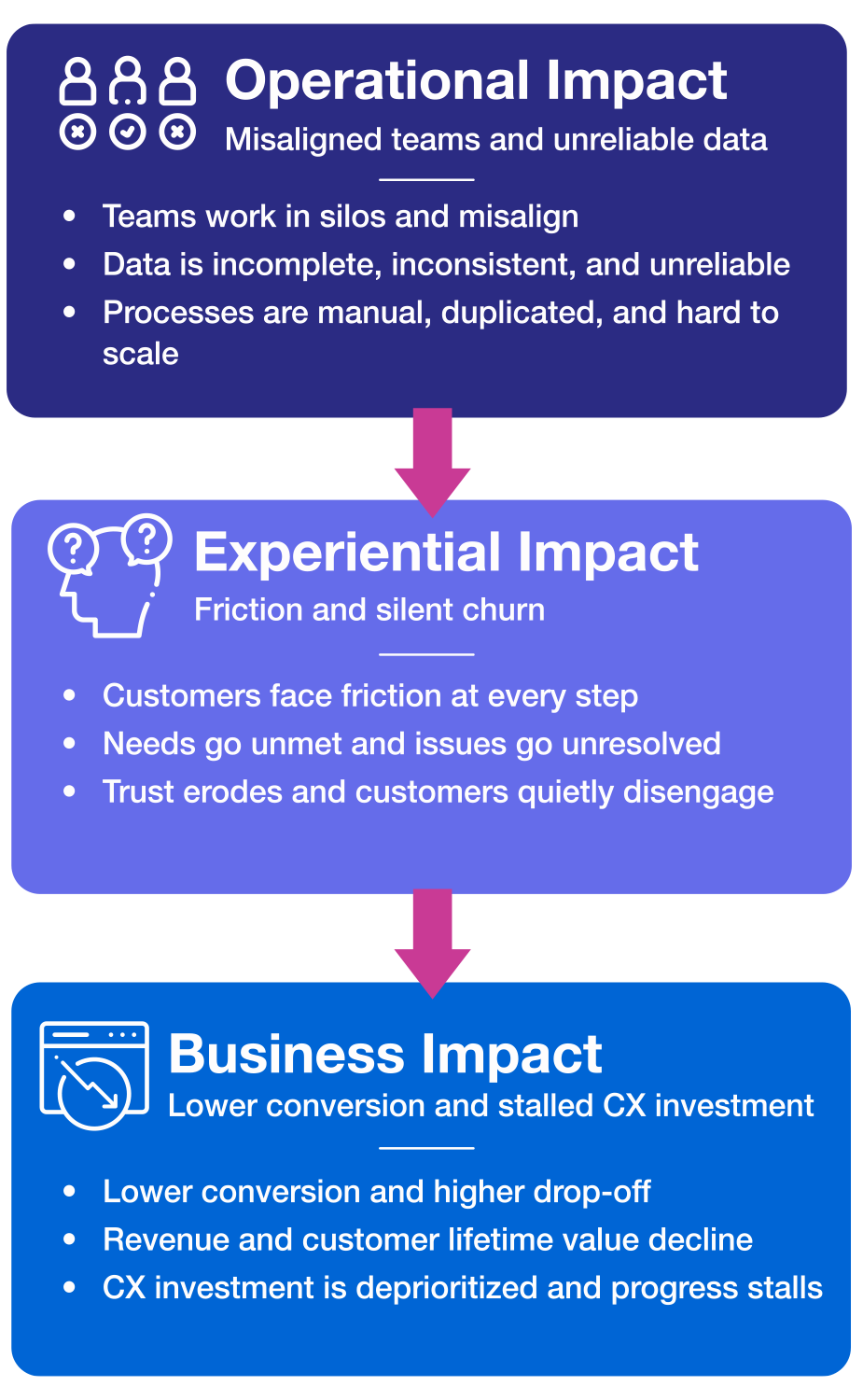
Operational cost is the foundation. Everything else depends on it. Siloed teams make decisions from data they don’t trust. Rework eats away at efficiency. Governance slows down change instead of enabling it. This cost rarely shows up on a single dashboard. But it’s constant. And it’s why well-intentioned CX investments stall before they pay back.
Experiential cost is what customers actually encounter. They repeat themselves across channels, hit dead ends in digital experiences, and lose a little confidence in the brand with each disconnected handoff. Most don’t complain. They simply move on, quietly enough that the organization never learns why.
Business cost is what lands on the P&L: lower conversion, higher cost to serve, retention erosion, and slower time to value from CX investments. When the customer experience is fragmented, the math works against the business no matter how strong the product.
The opportunity is the inverse of each of these. When the operating model is connected, the operational drag eases, customer confidence builds, and the business impact moves in the right direction.
Why Broken Experiences Outlast High-Performing Teams
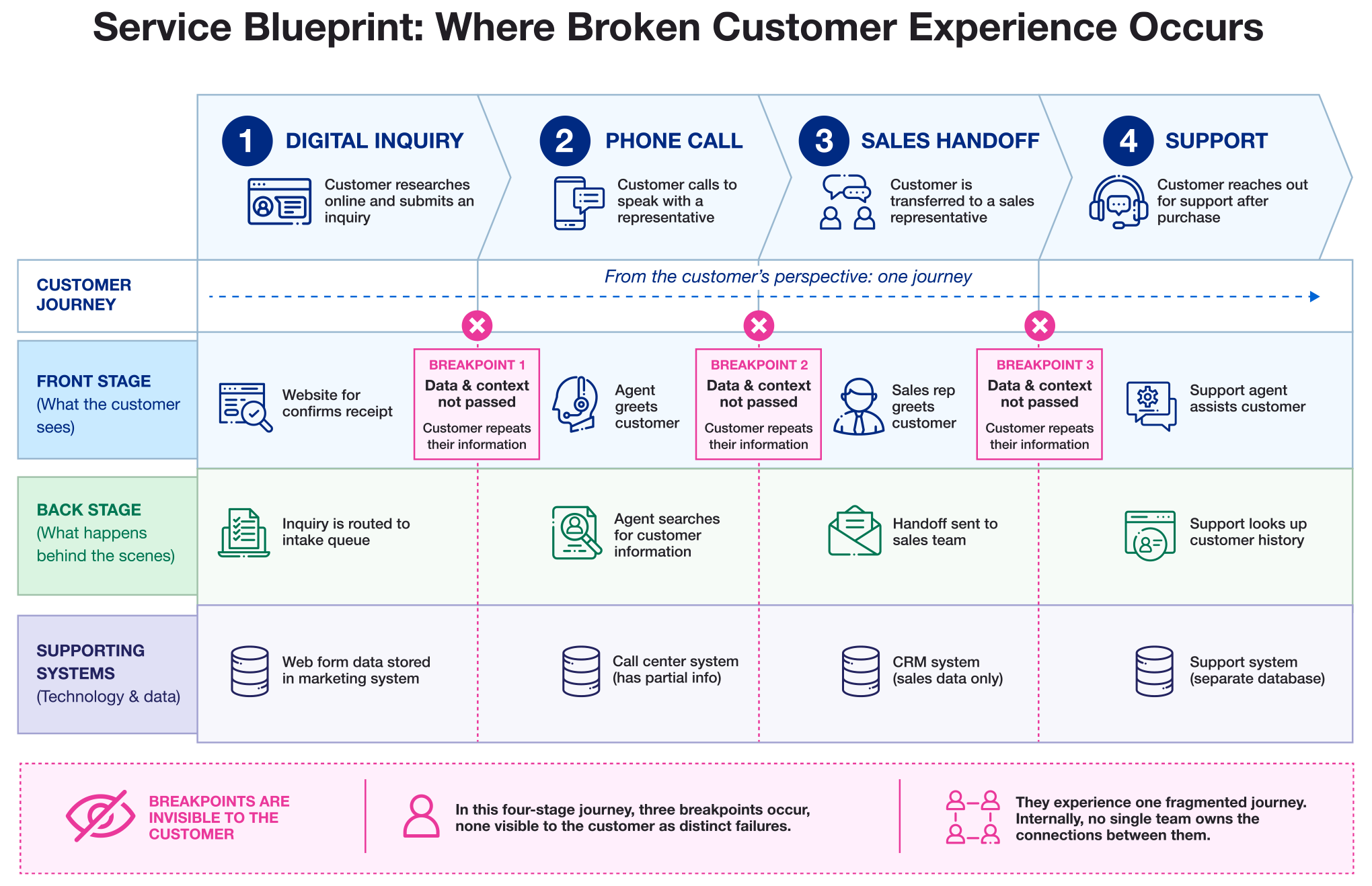
Here’s the scenario most organizations will recognize. A customer starts online, fills out a form, calls for clarification, gets routed to sales, repeats the same information, receives a generic follow-up email two days later, and then contacts support because the next step still isn’t clear. Every team did its job. The customer still experienced the journey as fragmented, depersonalized, and disconnected from a brand that should have known them better.
That’s an execution problem, but one that no single team can solve, because the breakdown happens between teams rather than inside any of them. It’s an operating model problem, and it sits at the intersection of people, process, and technology. In most organizations, process is where the gaps are biggest and where the highest-return fixes are hiding. This is where customer journey orchestration becomes an operating model issue, not just a channel coordination issue: it requires shared ownership, connected data, decision rights, and measurement that follows the customer across the journey. The questions executives end up facing are about accountability, decision rights, and return: who owns the end-to-end journey when no single function controls it, who resolves conflicts when functions optimize for different outcomes, and how the business knows its CX spend is compounding rather than leaking value.
Siloed Teams Optimize for Metrics, Not Customers
Marketing optimizes acquisition, sales optimizes conversion, service optimizes resolution, digital teams optimize channel performance, and operations optimize efficiency. Customers, meanwhile, experience one journey.
What feels optimized inside the organization often feels disconnected outside of it. Each team can hit its targets while the customer still walks away frustrated, because no single team owns the connections between them. That’s not a people problem. It’s a process and ownership problem, and it can be changed.
Handoffs Are Where Broken Experiences Hide
Experiences break at customer touchpoints; where a confusing form or a clumsy call flow creates real friction. They also break in the handoffs between touchpoints, and that’s the part most organizations overlook. Most organizations have touchpoint owners, but few have clear ownership for transitions, handoffs, and cross-channel continuity. That’s where friction accumulates, trust erodes, and data goes dark, because no one is responsible for what happens between teams.
Teams invest heavily in improving individual interactions, while the CX breakdowns that no one is watching tend to happen in the spaces between them, which is to say between channels, between teams, between departments, and between policy and delivery.
In one public sector engagement, customers contacting a city government about a single service issue were routinely transferred two or more times before reaching the right department. Staff knew their own area well, but nobody owned the connection between them. Formalizing handoff protocols and clarifying ownership reduced interdepartmental transfer cycles by approximately 20 percent in the areas reviewed.
This isn’t unique to any one organization. Siloed ownership means no one is accountable for cross-functional outcomes. A missing operating model means strategy and execution decouple. Data distrust means dashboards don’t drive decisions even when the data exists.
Misaligned Definitions Break the Data
A lead means one thing to marketing and something else to sales, a conversion is counted differently depending on which dashboard you open, and the same metric produces different numbers based on which team is asking.
In our experience, the most common root cause isn’t technology. It is that no one agreed on what a key term like conversion or lead means before anyone built a dashboard. When definitions aren’t shared, the data tells different stories depending on who is asking, and the experience can’t be managed as one connected whole.
When teams do align on definitions, the data stops being a source of debate and starts being a tool for decisions. That shift alone changes how quickly an organization can identify where the customer experience is breaking and act on it.
Broken Customer Experience: On-the-Ground Signs
A broken customer experience tends to show up the same way regardless of industry:
- Customers repeat information across channels because systems don’t share context.
- A customer moves from a chatbot or web form to a live agent and has to start over, because the digital and human channels aren’t connected.
- Staff can’t see enough customer history to respond with confidence.
- Customers get bounced between teams with no clear path to resolution.
- Important journey moments are owned by several groups at once, or sometimes by no group at all.
Each of these is a symptom, and the cause is usually the same. It’s an operating model that was built around internal functions rather than around customer outcomes.
In one engagement, a well-designed journey improvement program lost momentum within months of launch. The recommendations weren’t wrong. The work depended on a single internal champion, and when that person’s role changed, there was no cadence, governance structure, or reinforcement rhythm to sustain it. The improvements drifted. That experience shapes how we think about adoption from the start of every engagement now.
The encouraging part is that the path from this state to a connected, compounding experience is clearer than most organizations expect. Across client work, the pattern tends to show up in three ways: data mistrust, broken experiences, and MarTech investments that aren’t configured to create value. The specifics vary, but the underlying issue is consistent. CX investment doesn’t compound until the operating model behind it is connected.
A client story with a global education provider demonstrates what becomes possible. Testing was siloed, execution was inconsistent, and momentum had stalled. When the work shifted from optimizing individual touchpoints to diagnosing where the customer experience was breaking and building a structured measurement approach across the journey, the results changed quickly. Aligned teams, a reliable measurement approach, and a testing program with clear governance came first. Then friction dropped and conversion improved, with a 47 percent test win rate and roughly $600K in attributed revenue impact.
The path from a broken experience to a connected, compounding one is clearer than most organizations expect. But it requires a different approach, one built around investment discipline rather than activity. In part two of this series, I walk through the seven operating-model shifts that make CX investment actually compound.

Discover Where Your CX Value Is Leaking
It starts with diagnosing the issues. To help companies take the first step, we provide a complimentary CX ROI Diagnostic to identify where value is leaking, estimate the upside, and surface high-impact opportunities you can act on. No commitment, just clarity on where CX investment is stalling and where the return is most likely to come from.
Frequently Asked Questions
What causes a broken customer experience?
A broken customer experience is usually caused by an operating model that was built around internal functions rather than customer outcomes. That often shows up as siloed teams optimizing their own metrics, inconsistent data definitions across functions, unclear handoff accountability between channels, and no shared owner for the end-to-end journey. In my experience, the most common root cause isn’t technology. It is that no one agreed on what a key term like conversion or lead means before anyone built a dashboard, so the data tells different stories depending on who is asking, and the experience can’t be managed as one connected whole.
What is the business impact of a broken customer experience?
The impact is significant and often underreported. It includes lower conversion, higher cost to serve, increased churn, and slower time to value from CX investments. The operational cost is the hardest to see but the most constant: rework, stalled decisions, and team time spent reconciling conflicting data rather than improving the experience. By the time the revenue impact shows up on a dashboard, the operational damage has usually been accumulating for months.
What does a broken customer experience look like on the ground?
It tends to show up the same way regardless of industry: customers repeat information across channels because systems don’t share context, staff can’t see enough customer history to respond with confidence, and important journey moments are owned by several groups at once, or by no group at all. Each is a symptom of an operating model built around internal functions rather than customer outcomes.
To learn what to do about this check out part two of this series, How to Fix Broken Experiences for Good. It provides seven shifts that make your CX investments compound and deliver more impact.