

Organizations invest millions in analytics platforms, yet something strange happens after launch. Teams quietly return to spreadsheets. Managers wait for someone else to validate the numbers before acting. Dashboards that took months to roll out sit untouched while decisions happen in hallways and email threads. Dashboard reliability, not just dashboard access, determines whether teams actually use what you build.
This isn’t a technology problem. It’s a trust problem. And it costs far more than most organizations are willing to admit.
Data distrust is one of the three core CX problems that prevent companies from turning their investments into results. When teams can’t trust the data, they can’t act on it. When they can’t act on it, the experience suffers, decisions stall, and the strategic ceiling of the entire organization quietly lowers.
The good news: it’s fixable. But not by buying a new platform.

The Real Cost of Data Distrust
Data distrust doesn’t announce itself as a strategic failure. It looks like slow approvals. It looks like a dashboard that nobody opens. It looks like a leader who asks for “one more verification pass” before committing to a recommendation that should have been obvious three weeks ago.
The cost lands on three levels, and most organizations are only seeing one of them.
Operational impact is where the damage begins. When teams don’t trust the data, decisions don’t get made from a shared scoreboard. They get made from whoever has the most persuasive spreadsheet. Analysts spend their time chasing discrepancies and fielding skepticism instead of generating insight. Governance gaps mean the logic behind a metric lives in one person’s head, and the moment that person leaves, institutional knowledge walks out with them. According to recent research, analytics leaders estimate that 26 percent of organizational data is untrustworthy. When more than a quarter of the foundation is suspect, aligned teams and trusted decisions become structurally impossible.
Experiential impact is what customers feel downstream. Personalization arrives too late, if at all, because the behavioral signals that should trigger it were never acted on. Retention models never get built because the team can’t agree on what a “customer” means. Journey improvements stall in committee because no one can confirm the baseline. Friction stays in the experience, not because no one wants to remove it, but because no one trusts the data enough to justify the investment.
Business impact is where the cost compounds. Organizations with mature, trusted analytics environments achieve a 2x-5x ROI from data and analytics, according to Forrester. The organizations still fighting data distrust never get close. Extended decision cycles, defensive resource allocation spread thin across too many initiatives, and missed retention signals translate directly into revenue erosion. And unlike a broken touchpoint, which shows up in a support ticket or an NPS score, collapsed ambition never appears on a dashboard at all.

I can’t even think about that right now. I just need to be able to trust my page view numbers
Why Data Distrust Almost Never Starts with the Data
The instinct when a dashboard breaks is to blame the tool, the implementation, or the data team. That instinct is almost always wrong. The technology is the messenger. The root cause is organizational.
On a recent client call, the conversation turned to what better analytics could unlock. What would you optimize first? What CX outcomes would you prioritize? The client stopped mid-sentence.
“Dude, I can’t even think about that right now. I just need to be able to trust my page view numbers.”
That’s not a data quality complaint. That’s a description of collapsed ambition. Organizations don’t just make slower decisions when they can’t trust their data. They stop imagining better ones. Personalization, retention modeling, journey optimization, CX strategy: none of it is accessible when the most foundational data needs go unmet. The strategic ceiling lowers not with a crash, but with a quiet resignation that better is simply not possible right now.
Research shows that 67 percent of organizations do not fully trust the data used in decision-making. The majority of companies are making strategic decisions while silently questioning the foundation beneath them.
Four Patterns That Accelerate the Collapse in Data Trust
Data distrust rarely arrives all at once. It accumulates, one broken metric, one contradicting report, one campaign that launched without telling the analytics team. Together they teach the organization a corrosive lesson: the data can’t be relied on.
The shadow data ecosystem. When official data is questioned, teams stop waiting and start building their own. Spreadsheets multiply. Analysts pull numbers independently. Before long there are three versions of revenue in the building and nobody can reconcile them. The shadow ecosystem doesn’t just reflect distrust. It deepens it.
The undeclared change. A developer pushes an update. A campaign launches. A redesign goes live. Nobody told the data team. Metrics shift, anomalies appear, and analysts spend days investigating what looks like a data problem but was actually a business event. Trust erodes not because the data was wrong, but because the organization treated analytics as a spectator rather than a stakeholder.
Inconsistent definitions. Marketing counts one version of a customer. Finance counts another. Product counts a third. Everyone feels correct because within their own context they are. But when those numbers meet in a leadership meeting, the conversation stops being about the business and starts being about whose spreadsheet to believe.
Organizational amnesia. The logic behind a metric lives in one person’s head. Why is revenue calculated this way? Why does this segment exclude those users? When that person leaves, the answers leave too. New team members inherit the skepticism of their predecessors without understanding its origin, and the cycle of distrust quietly resets.
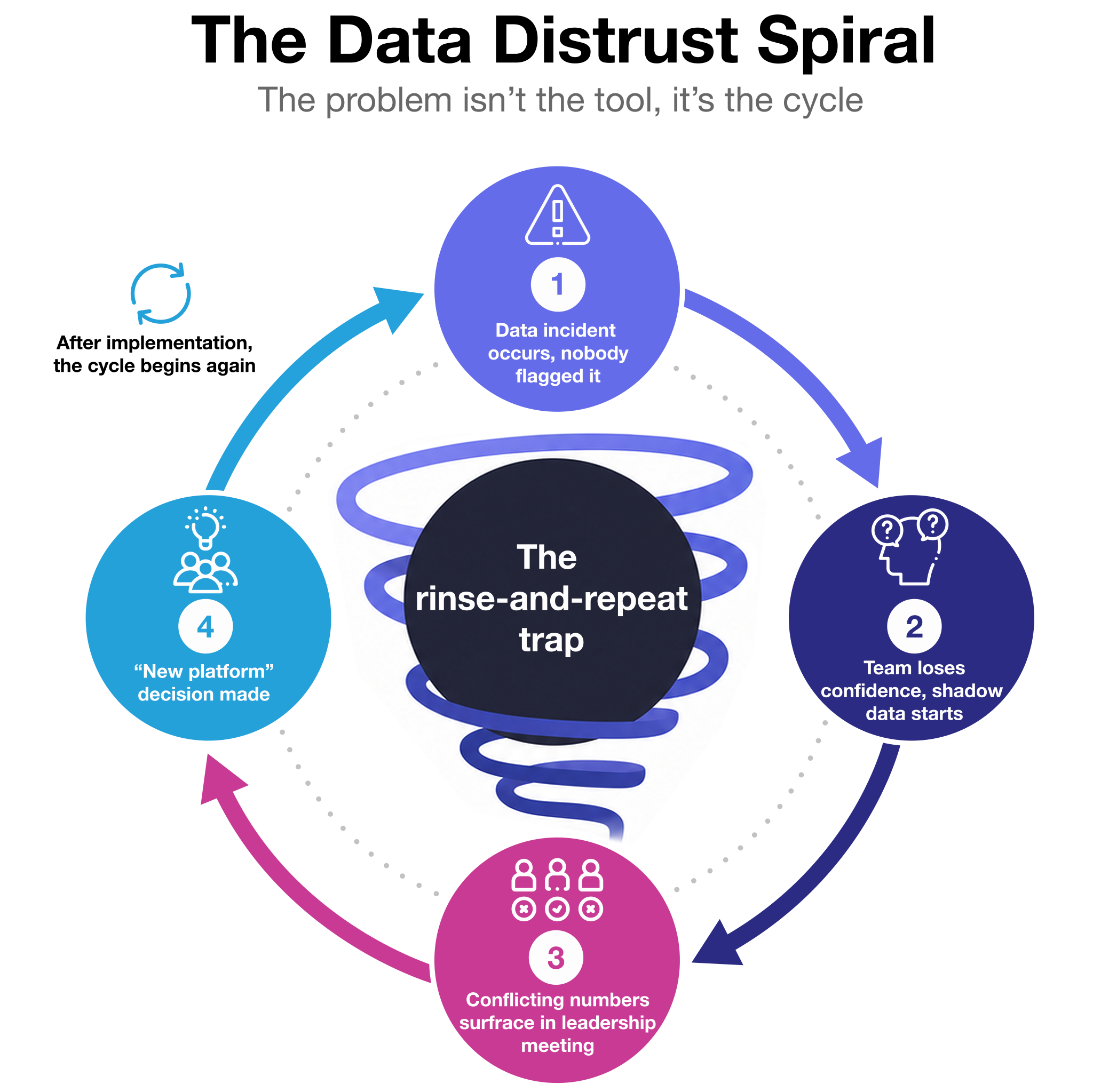
The Rinse-and-Repeat Trap
When data distrust reaches a tipping point, organizations rarely look inward. They look at the tool.
The data team gets blamed. The platform gets scrutinized. Someone in a budget meeting says what everyone has been thinking: maybe they need a new solution. A new implementation begins. There’s energy, optimism, and a clean slate. For a while, things feel better.
Then the same patterns re-emerge. Unexplained anomalies. Contradictory reports. Untagged marketing efforts. The corrosive lesson reasserts itself, and now the organization is six figures deeper, twelve months behind, and no closer to trusted data than when they started.
This is the broken Customer Experience playbook in its most expensive form: tech-first over value first, dashboards instead of decisions, complex marketing stacks with flat returns. The new analytics platform doesn’t fix the governance gaps, the communication breakdowns, or the organizational habits that created the data distrust. It just buys another eighteen months before the same conversation happens again.
Escaping this trap requires asking the question the new analytics platform purchase was designed to avoid: is this a technology problem, or did we just fund another lap of the same cycle?
Data Distrust is a Hidden Tax on Every CX Decision
The verification tax that data distrust creates compounds faster than most organizations realize.
A Customer Experience (CX) leader identifies a pattern suggesting a customer retention opportunity. Before allocating resources, analytics must confirm the methodology. Finance reconciles the numbers. Operations checks whether the pattern matches frontline experience. By the time everyone agrees the signal is real, the window has closed.
This tax appears in four forms:
- Extended decision cycles. Approvals that should take a day stretch into weeks while stakeholders seek independent confirmation.
- Defensive resource allocation. Leaders spread investment across multiple initiatives instead of committing to clear signals, hedging because the data doesn’t feel safe to bet on.
- Accumulating opportunity cost. Patterns emerge and fade while teams debate whether insights are credible. The signal was real. The response arrived too late.
- Collapsed ambition. The most expensive cost never appears in a budget line. When foundational data needs go unmet long enough, leaders stop asking strategic questions because they know the answer will circle back to a data quality argument. The ceiling on what the organization believes is possible quietly lowers, and nobody logs that as a loss.
When data can’t be trusted, it stops being a shared scoreboard and becomes a burden to maintain. The data team stops creating value and starts playing constant defense: chasing discrepancies, fielding skepticism, and rehashing numbers that should have been settled months ago. The data should work for the organization. When trust breaks down, the organization ends up working for the data instead.

Rebuilding Data Trust as Infrastructure, Not a Clean-up Project
Before data trust can be rebuilt, the system that broke it needs to be examined honestly.
Most organizations skip this step. They identify the symptoms, a broken dimension, an inconsistent definition, a dashboard nobody uses, and move directly to remediation. A cleanup that doesn’t address the underlying conditions is just buying time. The same gaps in communication, ownership, and organizational process that created the distrust will quietly reassert themselves into whatever gets built next.
The most important questions at this stage aren’t technical. They’re organizational.
Who was responsible for this and didn’t know it? Where did communication break down between the business and the data team? What shortcuts were taken that everyone knew were brittle? What did this organization’s behavior communicate about how seriously it treated analytics as a shared responsibility?
Answering those questions honestly is uncomfortable. It’s also the only way to ensure that rebuilding trust in the data is a permanent fix rather than the first lap of another rinse-and-repeat cycle.
Rebuilding data trust has a structural prerequisite: the organization has to be able to see itself clearly. This includes not just the data, but the system around the data. How are metrics calculated? Who owns the logic? What happens when that person leaves or is unavailable? When important context only lives in someone’s head, data trust is a single resignation away from collapsing again.
Four Conditions that Make the Rebuild Hold
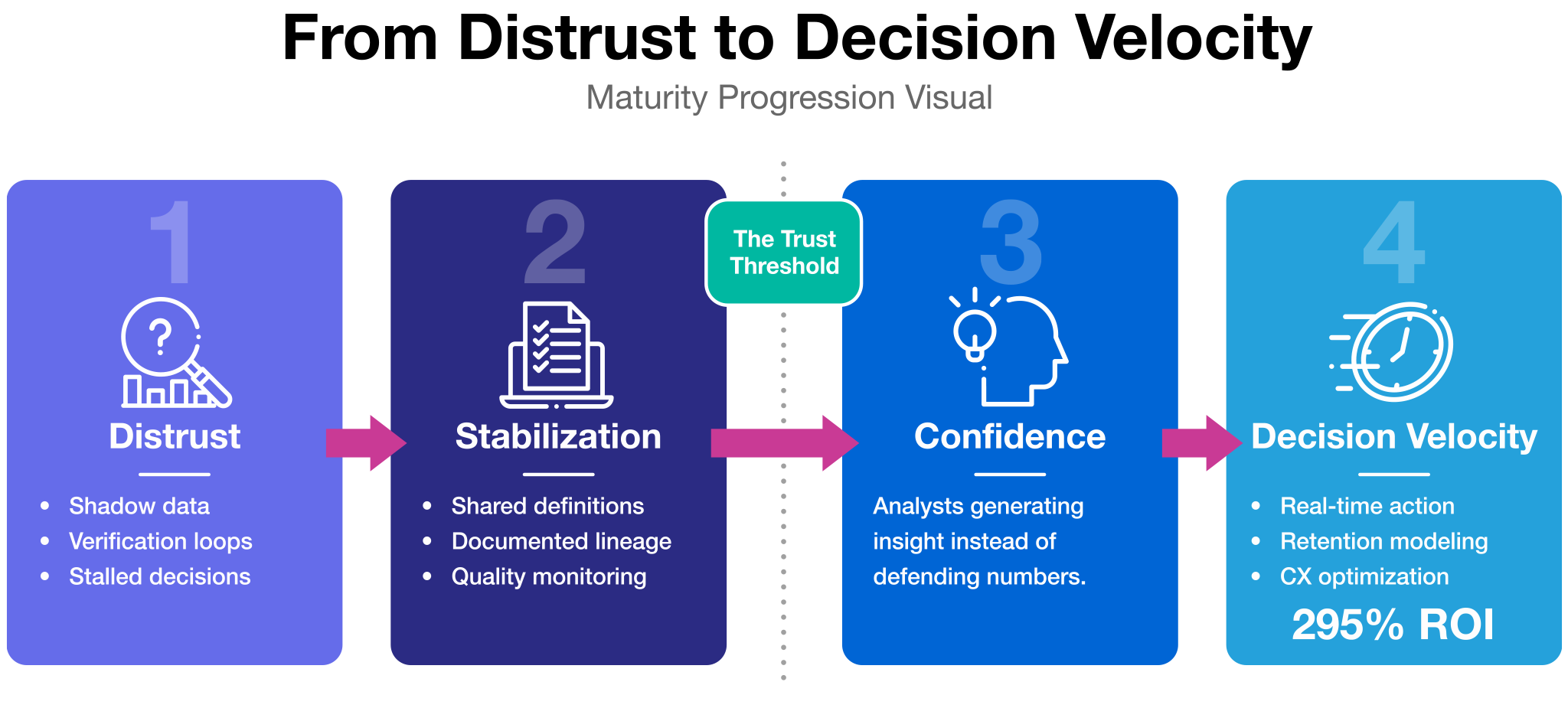
Organizations that rebuild data confidence sustainably establish these four conditions:
1. Documented decisions and use cases. Before a single metric is defined, the organization should be able to answer: what decisions does this data need to enable? What questions will leadership, analysts, and frontline teams need to answer? Every downstream documentation choice, what to track, how to define it, who owns it, should trace back to this foundation. Data that isn’t connected to a decision is documentation for its own sake.
2. Documented data lineage. Every metric traces back to its source and to the decision it was built to inform. Methodology becomes transparent rather than mysterious, and the business logic behind each number is visible to anyone who needs it, not just the person who built it.
3. Shared definitions. Core terms like “customer,” “conversion,” and “revenue” mean the same thing across every department, every dashboard, and every leadership meeting. Governance ensures those definitions are written down, ratified, and survive personnel changes.
4. Visible data quality metrics. Reliability is measured and monitored, not assumed. Teams know when something breaks before a stakeholder finds it first.
Technology alone won’t restore trust in your data and decisions. Confidence grows through repeated small wins. Teams need to see the data prove itself reliable at the operational level before they’ll stake strategic decisions on it.
From Data Distrust to Decision Velocity
Once the scoreboard can be trusted, the organization stops asking “is this number right?” and starts asking “what should we do about it?” That shift, from data maintenance to customer experience optimization, is where measurable business value lives.
Data trust is not a governance checkbox. It’s the speed limit on the road from data to insight and insight to action. The organizations that internalize this are the ones that can finally stop fighting fires and start making decisions.
A leading real estate brand had invested heavily in customer experience optimization, but couldn’t unlock the return. Data was fragmented across systems. MarTech decisions were vendor-driven. There was no clear link between CX activity and revenue. When the work shifted from platform configuration to rebuilding the data foundation: shared definitions, documented lineage, a structured measurement system tied to business decisions. The results followed fast.
The operational impact came first: a 33 percent increase in trusted analytics access, giving teams the shared scoreboard they’d been missing. The experiential impact followed: journey friction was diagnosed and reduced, with a 50 percent increase in lead form completion. The business impact closed the loop: a 62.3 percent reduction in cost per lead, a 28 percent increase in bookings, and $280K in monthly recurring revenue attributed directly to CX improvements.
That’s not what a platform upgrade produces. That’s what a trusted data foundation produces.
Data trust is not a governance checkbox. It’s the speed limit on the road from data to insight and insight to action. When trust breaks down, you stop working with your data. You start working for it.

Stop Defending Your Data. Start Deciding with It.
Data distrust isn’t a sign that the technology failed. It’s a sign that the organization never built the infrastructure, the governance, or the shared ownership that analytics requires to be trusted at scale.
The operational cost is analysts playing constant defense instead of generating insight. The experiential cost is personalization that arrives too late, retention signals that go unacted on, and journey improvements that stall in committee. The business cost is real: slower decisions, defensive resource allocation, and a strategic ceiling that keeps getting lower.
The path forward isn’t a new analytics or marketing platform. It’s governance that establishes shared definitions, lineage that makes methodology transparent, quality monitoring that surfaces problems before stakeholders do, and an organizational commitment to treating analytics as a shared responsibility rather than a data team problem.
If your dashboards are underused or your teams silently question the numbers, the issue isn’t the tool. It’s trust in your data. And the fastest way to diagnose it is an honest look at the system around the data, not just the data itself.
Ready to move from data distrust to decision velocity? A focused Analytics Audit by our experienced consultants identifies where trust in your data is breaking down, which governance gaps are costing you the most, and where rebuilding the foundation will create the greatest return on your analytics and marketing investment.
BlastX Consulting is a digital consultancy trusted since 1999. We help organizations identify where CX investments are leaking value and build the system to make them compound. This isn’t theory. This is pattern recognition gleaned across more than 1,500 initiatives across more than 300 clients.
If broken customer experiences are contributing to your data trust challenge, start here: Your customer journey isn’t broken. Your operating model is.
Frequently Asked Questions About Data Distrust in Analytics
What is data distrust and why does it happen?
Data distrust occurs when teams lose confidence in the accuracy, consistency, or reliability of organizational data. It almost never starts with a technology failure. The root causes are organizational: governance gaps, inconsistent metric definitions across teams, poor communication between business and data functions, and an operating model that treats analytics as a spectator rather than a shared responsibility. Once trust erodes, it compounds through shadow data ecosystems and verification loops that slow every decision.
What does data distrust cost an organization?
The cost of data distrust operates on three levels. Operationally, it creates misaligned teams, extended decision cycles, and analysts spending time defending numbers instead of generating insight. Experientially, it delays or prevents personalization, retention modeling, and journey improvements because teams can’t agree on a baseline. At the business level, it produces defensive resource allocation, missed retention signals, and a compounding opportunity cost. Research shows organizations with mature analytics environments achieve 295 percent ROI over three years. Organizations fighting data distrust never get close.
Why do organizations keep replacing analytics platforms instead of fixing data trust?
Replacing the platform feels faster than fixing the organization. A new implementation creates energy, a clean slate, and a visible deliverable. But the governance gaps, communication breakdowns, and organizational habits that created the distrust follow the data into the new system. Within 12 to 18 months, the same patterns re-emerge. Breaking this rinse-and-repeat cycle requires addressing the root cause first: the people, process, and governance conditions that allowed distrust to develop, not the technology that surfaced it.
What are the first steps to rebuilding data trust?
Rebuilding data trust starts with an honest organizational audit, not a technical one. The key questions are: who was responsible for the breakdown and didn’t know it, where did communication fail between the business and the data team, and what shortcuts were taken that everyone knew were brittle. From there, four conditions create a durable rebuild: documented decisions and use cases that anchor every metric to a business question, documented data lineage, shared definitions ratified across departments, and visible data quality monitoring that surfaces problems before stakeholders find them.
How is data distrust connected to broken customer experiences?
Data distrust and broken customer experiences reinforce each other. When teams can’t trust the data, they can’t diagnose where the customer experience is fragmenting, which handoffs are causing friction, or which journey moments are driving churn. Personalization stalls. Retention modeling never gets built. Journey improvements sit in committee. Fixing the data foundation is a prerequisite for fixing the experience at scale. For more on how broken experiences compound the problem, see fixing broken customer experiences.