
By the numbers: Gartner predicts that by 2028, half of all organizations will adopt a zero-trust posture toward their own data, a direct response to the growing volume of unverified AI-generated content moving through enterprise systems.
Gartner’s 2026 CIO and Technology Executive Survey found that 84 percent of respondents expect their enterprise to increase funding for generative AI this year. That’s a big number, and most leadership teams are excited. What they haven’t priced in is the side effect: a flood of AI-generated and AI-influenced data moving through the same systems that power your reporting, your forecasting, and your customer experience (CX) decisions.
That’s not a security headline. It’s a customer experience headline with data distrust front and center.
Organizations can no longer implicitly trust data or assume it was human generated.
Think about what that means for your team. Every personalization engine, every journey map, every voice-of-the-customer dashboard you’ve built is only as good as the data underneath it. When your leaders stop trusting that data, they stop acting on it. Decisions slow down. People fall back on gut instinct, or worse, on whoever talks the loudest in the room. The investment you’ve already made in analytics, MarTech, and customer experience strategy stops paying you back, not because the strategy was wrong, but because nobody believes the inputs anymore.
This is the data distrust problem, and in our work it’s one of three constraints we see breaking CX programs at organizations of every size:
- data distrust and fragmentation,
- broken customer experiences,
- and underperforming MarTech stacks.
Of the three, data distrust is the quietest. It rarely shows up as one dramatic failure. It shows up as a hundred small hesitations: a report nobody fully believes, a metric two departments define two different ways, an executive who asks “where did this number come from?” one too many times.

Why Data Distrust Is Compounding in the Age of AI
For most of the past decade, data distrust was a data quality problem. Messy tagging, inconsistent definitions, disconnected systems—all of it made reports unreliable, but the data underneath was still human-generated and traceable to a known source. That assumption doesn’t hold anymore.
As generative AI gets embedded into research, content production, and even customer interactions, you’re absorbing data you didn’t create and can’t fully verify. AI-written product descriptions, AI-summarized customer feedback, AI-generated survey responses, AI-assisted reporting—all of it enters the same pipelines that feed your CX dashboards and personalization engines. Gartner’s prediction that half of organizations will move to a zero-trust data posture by 2028 isn’t really a forecast about technology adoption. It’s a forecast about how much harder it’s about to become to know whether the data behind your next decision reflects reality. In fact, I addressed some of this in The Hard Truths about AI and Data, an article I wrote a while back for Fast Company.
We see this compounding effect show up in three specific ways for CX leaders:
- AI-assisted reporting can mask the inconsistencies that used to be visible. A human analyst reconciling two conflicting reports tends to notice the conflict. An AI summarization layer smooths over that same conflict and hands you one confident-sounding number, hiding the disagreement instead of resolving it.
- Synthetic content is polluting your sentiment signals. AI-generated reviews, AI-moderated research, and AI-written support responses all introduce noise into the exact signals your CX team relies on to understand what customers actually think.
- Speed is skipping the governance step. The pressure to move fast with AI tools often means governance gets bolted on later, if at all, so organizations end up automating distrust at scale rather than catching it earlier.
None of this means you should slow down your AI adoption. It means the foundation underneath that adoption, your data layer, has to be more disciplined than it’s ever been. That’s the same lesson that comes out of the data renovation work below, just compressed into a much shorter timeline.
How Data Distrust Takes Hold in Customer Experience Programs
Data distrust is almost never the result of one bad decision. It accumulates.
In our experience, it follows a familiar arc. A company invests early in a strong analytics implementation. Over years, multiple brands, platforms, or business units build on that foundation, often with separate engineering teams working independently. Each team is solving its own immediate problem, and none of them is wrong to do that. But without a shared standard, small inconsistencies compound. One team tags a content type one way. Another team tags that same content type three different ways. A third team never updates its tracking.
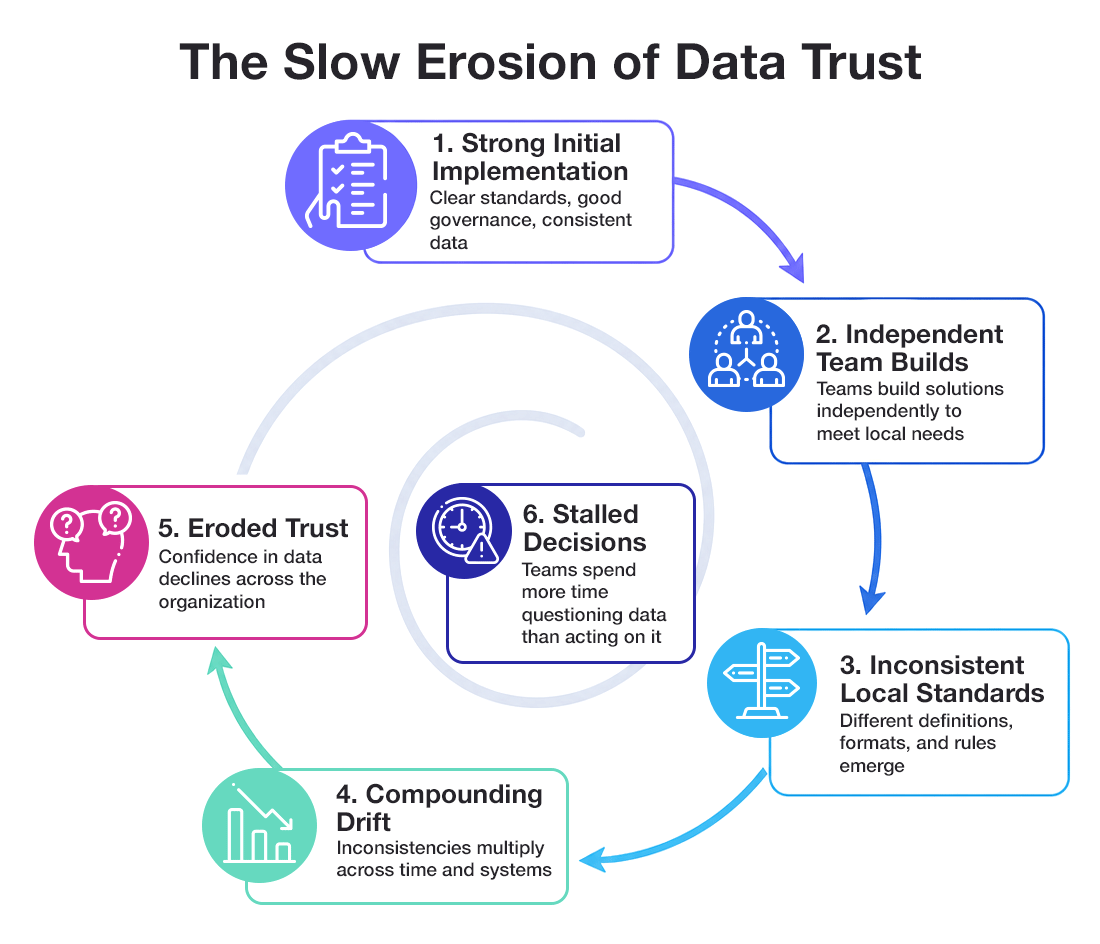
Nobody planned for the data to become unreliable. It just eroded, one well-intentioned local decision at a time, until the people who needed to act on it couldn’t tell what was real anymore. We see this pattern across nearly every industry we work in: retailers running parallel ecommerce platforms, healthcare systems integrating acquired practices, travel and hospitality brands managing multiple booking channels. The technology is different in each case. The underlying mechanism, independent teams making locally reasonable decisions with no shared standard, is the same.
We saw it firsthand with a multi-brand news organization that had relied on Adobe Analytics for more than a decade. The organization distributed content across websites, iOS and Android apps, Google Accelerated Mobile Pages, and Facebook Instant Articles, with a dedicated engineering team and report suite for each brand and platform. It made sense on paper. In practice, individual teams had invented their own tracking standards over time, and no one way existed to monitor, enforce, or update tracking across the organization. A Content Type Report that should have offered a clean view of performance instead produced more than 100 line items, most requiring manual cleanup before anyone trusted the numbers enough to use them.
The fix wasn’t a new tool. It was a new standard that addressed data distrust and was treated as a capital investment rather than a one-time project:
- Start with discovery, not specs. The work began with stakeholders from each brand, building a real understanding of the business questions the data needed to answer, not just the technical details of how it was being collected.
- Audit everything, assume nothing. From there, a full Adobe Analytics audit reviewed every data point across every website and app to determine its actual purpose, rather than assuming legacy tracking was still relevant.
- Document one standard, give every team a map to it. The audit findings became a Solution Design Document defining one global tracking standard, then implementation guides gave each engineering team specific, brand-level instructions to get there without losing the autonomy to run their own roadmap.
The result was a trusted data layer fully aligned across every brand and platform. The same Content Type Report that once required manual interpretation now returns a short, clean, trustworthy list. The organization retired individual report suites in favor of virtual report suites, cutting server call volume and creating meaningful cost savings alongside the analytics gains. Just as important, the analytics team stopped spending its time cleaning data and started spending it finding insights. Trust in the data came back, and so did the organization’s ability to act on it with confidence, a shift that mattered as much for morale as it did for the balance sheet.
By the numbers: Gartner estimates the average annual cost of poor data quality at $12.9 million per organization, a figure that remains the industry’s most-cited benchmark for the cost of distrusted data.

Treating Data Trust as a Capital Investment, Not a Cleanup Project
Most organizations treat data quality as a maintenance task, something IT or analytics handles quietly in the background. That framing is exactly why distrust keeps coming back. A one-time cleanup degrades the moment a new platform launches, a new team joins, or a new AI tool starts generating content and data nobody fully vetted.
Many CX teams are drifting dangerously close to the event horizon of metric obsession.
Schmidt’s warning lines up with what we see in the field. Teams under pressure to prove their value default to producing more reports instead of more trustworthy ones, and the gap between activity and actual decision-making confidence keeps widening. More dashboards will not solve a trust problem. They usually deepen it, because every new dashboard inherits whatever inconsistencies already exist underneath it.
The organizations that get this right treat data trust as capital to be governed, not a mess to be cleaned. In practice, that means a handful of disciplines working together, not a single fix:
- Assign clear ownership. Put a name on data standards across brands, platforms, and teams, so consistency doesn’t depend on goodwill or institutional memory.
- Audit on a cadence, not a crisis. Review the full data layer regularly, not just when something breaks or a new executive starts asking hard questions.
- Document the standard once, and keep it living. Capture it in a reference like a Solution Design Document that every team can implement locally without losing the context for why it exists.
- Monitor actively. Build in dashboards that catch drift within weeks, not years.
- Hold AI-generated data to the same bar. Treat provenance and verification as a standing governance requirement, not an afterthought bolted on once something goes wrong.
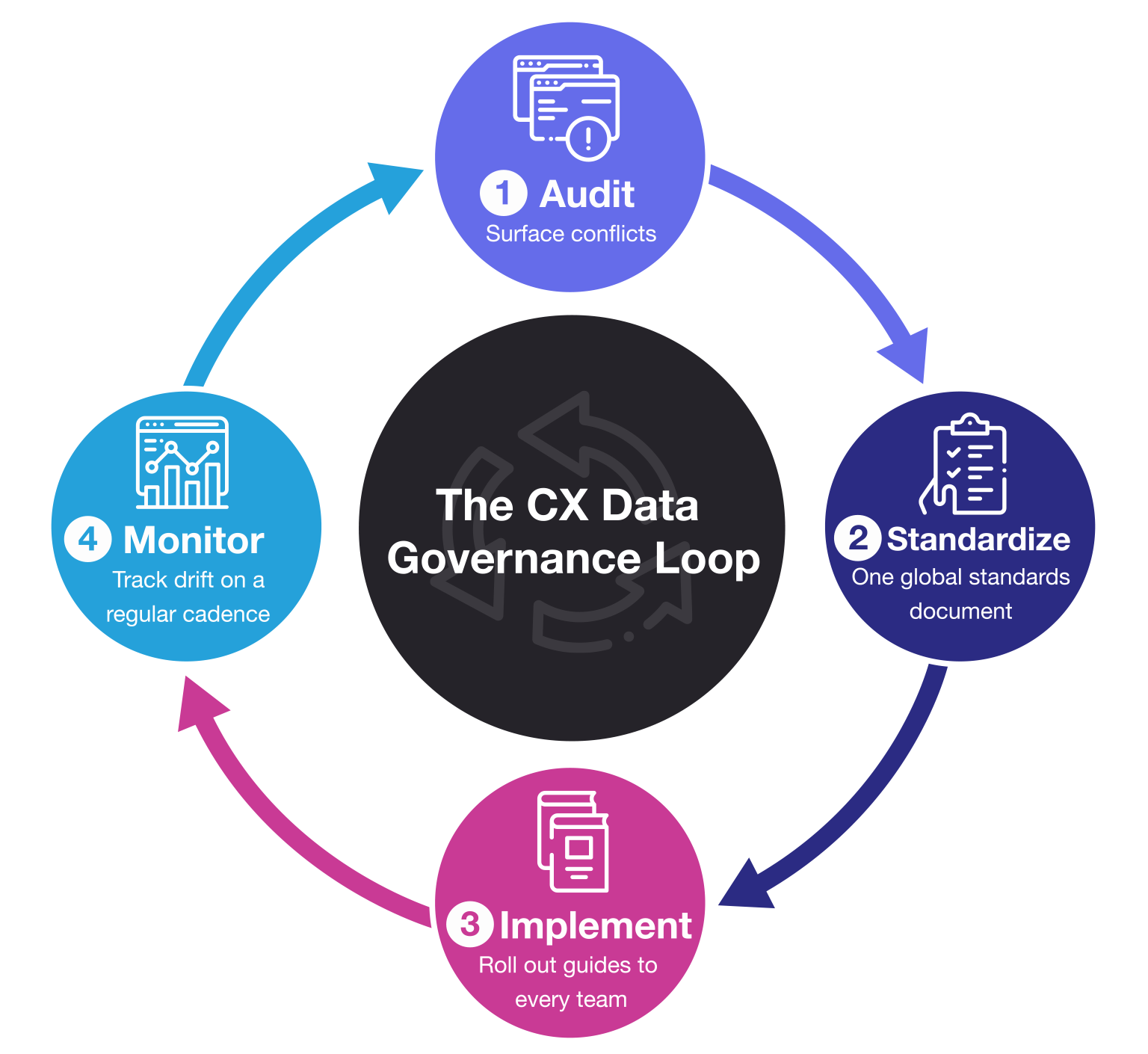
As Gartner’s research makes clear, this problem isn’t going away. As more AI-generated and AI-assisted content and data move through enterprise systems, the gap between organizations with disciplined data governance and those without it will only widen. The CX programs built on trusted data will compound their returns: faster decisions, more confident personalization, analytics teams freed up to find insight instead of fighting their own numbers. The ones built on data nobody quite believes will keep asking for more budget, more tools, and more dashboards to answer questions the data should already be answering.
How to Rebuild Trust in Your Customer Data
If your team hesitates before presenting a number, or if two reports never quite agree, that’s not a minor annoyance. It’s a signal worth taking seriously, and you don’t need an outside consultant to take the first few steps.
- Name where the hesitation lives. Sit down with the people who pull your core customer experience reports and ask them directly: which numbers do you double-check before sharing, and why? Their answer will point you straight at the inconsistency, whether it’s a tagging standard, a metric definition that differs by team, or a report nobody’s reviewed since the platform it was built on changed.
- Write the standard down, even if it’s imperfect. Decide on the one definition that should apply across every team touching that data. A standard that exists on paper, even if it’s not fully enforced yet, is already more useful than no standard at all.
- Trace one report back to its source. Pick the report your organization leans on most for customer experience decisions. If you can’t explain where every number in it comes from, that’s the report to fix first.
None of that requires new software or a big budget. It requires the willingness to ask uncomfortable questions about data your organization has been relying on for years.
If you go through that exercise and find the problem is bigger than your team has the bandwidth or mandate to fix, a Customer Experience ROI Diagnostic is there as a second set of eyes, not a sales pitch. It’s the same discovery-first approach behind the case study above: understand what’s actually happening in your data before recommending anything. Whether or not that conversation ever leads to working together, you’ll walk away with a clearer picture of where your data is, and isn’t, earning the trust your CX program is asking you to place in it.
You can see how this played out for one client in the full data renovation client story, or browse more client stories across customer experience strategy, analytics, and MarTech.
If you’re working through a data distrust problem of your own and want to think it through out loud, reach out. I’m happy to help.