

AI now delivers insights in seconds, but most teams still take weeks to respond. Explore four analytics & insights trends shaping speed, collaboration, and competitive edge in 2026.
In 2025, analytics platforms reached a new level of maturity. They expanded support for more complex data sources, better captured the deeper insights found within the full customer journey, and started to leverage integrated AI to help analysts realize a new level of time-to-model and time-to-insights creation. Adoption of this also broadened, proving that customer journey analytics is no longer aspirational. It is now operationally viable.
Platforms like Adobe Customer Journey Analytics (CJA) continued to gain traction. Adobe CJA reached functional parity with Adobe Analytics and opened new opportunities for deeper journey analysis and insight generation. Early generative AI features also began to emerge, and vendors show no sign of slowing AI integration in 2026.
Customer journey analytics became possible at scale in 2025. In 2026, the challenge shifts to making those insights truly actionable across the organization.
With that in mind, here are the top four analytics and insight trends that will define how organizations compete, collaborate, and deliver value in the year ahead.
Analytics Trend #1: Analytics Tools are Ready. Organizations are Not (Yet)
Here’s the paradox heading into 2026: we now have advanced customer journey analytics tools capable of real-time insight generation, yet most organizations still can’t tell a unified customer experience story.
The platforms work. The technology delivers. But organizational silos remain firmly in place.
Make no mistake: in 2026, the competitive advantage won’t be AI that finds insights. It will be organizations that can act on them cross-functionally in hours—not weeks.
After years of helping teams implement platforms like Adobe Customer Journey Analytics (CJA), one pattern is clear: the technical foundation is no longer the problem. Teams can now merge complex data sources, create unified dashboards, and enable self-service analytics that were out of reach just five years ago.
Yet, when asked about their biggest challenges, most leaders don’t cite platform limitations. Rather, those leaders consistently point to internal collaboration breakdowns.
Marketing owns campaign data. Sales controls the CRM. Support teams protect their ticketing systems. Each function optimizes for its own metrics while the customer journey remains fragmented.
The data backs this up. Over 95 percent of customer experience leaders have invested or plan to invest in data integration technologies, signaling a clear recognition that data silos are the real issue (Zendesk, 2025).
This misalignment is no longer just inconvenient, it’s dangerous.
AI is evolving faster than organizational structures can keep up. When AI detects a critical trend in minutes, but it takes three weeks to get the right stakeholders into a meeting, the insight rapidly depreciates.
What’s at stake? Without structural collaboration, even the best AI and analytics platforms can’t deliver competitive advantage. They’ll simply highlight problems teams can’t act on.
The Challenge: Making sure organizational alignment keeps pace with AI enablement.
Forward-thinking teams are already addressing the root issue: cross-functional misalignment. In 2026, they’re:
- Rearchitecting collaboration around shared customer KPIs
- Establishing data governance frameworks that clarify ownership and access
- Embedding analysts and data translators into business units to drive alignment
The opportunity for impact is real, as should be the sense of urgency. Organizations that break down internal walls now will unlock a new level of potential with AI-powered analytics. Those that don’t will find themselves with increasingly sophisticated tools but the same persistent blind spots.

Analytics Trend #2: AI is Collapsing the Time Between Question and Answer
AI is changing how quickly teams move from a business question to a useful answer. The traditional analytics request process has become inefficient. Submitting tickets, waiting through backlog queues, and reviewing dashboards weeks later is no longer sustainable. Today, business users can ask complex questions using natural language and receive contextual answers in seconds. Claire Vo, Founder of ChatPRD sums it up like this in a 2025 post on X:
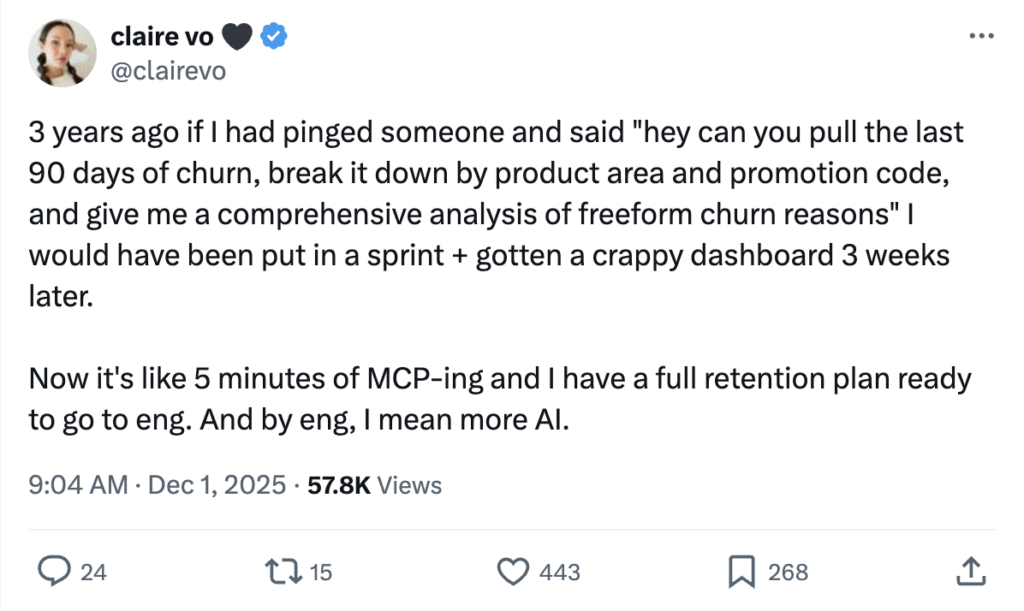
This shift shows no signs of slowing. By 2026, 40 percent of analytics queries are expected to be made using natural language. Many of these will bypass dashboards entirely.
The Challenge: Ensuring insight understanding keeps pace with access.
In organizations that are ready, this evolution is accelerating how teams engage with data.
- Marketers explore segmentation insights independently.
- Product leaders run live cohort analyses during planning sessions.
- Executives receive performance insights in the moment, not after decisions are made.
Faster access also introduces new risks. Many users interpret complex data without understanding the context. A 15 percent drop in conversion might seem urgent, but it could reflect seasonal patterns. Experienced analysts would know the difference. Business users might not.
This is why the role of analytics teams is shifting. Their work is no longer about delivering reports. It is about enabling smart decisions by helping others understand what the data actually means.
Key responsibilities now include:
- Ensuring data quality
- Providing business context
- Coaching teams on interpretation and use
The Best Moves for Analytics Leaders in 2026
To support this shift, analytics teams should:
- Expand data literacy programs across departments
- Create internal standards that reduce misinterpretation
- Embed analysts into business units as strategic partners
AI has eliminated wait time for answers. The organizations that succeed next will be the ones that turn those answers into action.

Analytics Trend #3: Proactive Insights will Replace Reactive Discovery
Historically, data quality and performance issues have been addressed reactively.
- Something breaks.
- Someone notices.
- A ticket is filed.
- Eventually, the issue is fixed.
By that point, the damage is already done and trust in the data is often compromised.
AI is shifting this dynamic. Automated systems can now detect emerging issues in real time. Instead of waiting for monthly reports to flag a problem, organizations are receiving alerts within hours or days of a trend developing.
This is a fundamental change in how analytics teams operate. The shift from “we discovered a problem” to “the system alerted us before it escalated” marks a turning point for digital experience management.
More than 60 percent of enterprises are already deploying AI-powered anomaly detection tools. Real-time monitoring adoption is rising across high-stakes industries like finance, healthcare, and infrastructure, with growth up 45 percent year over year.
These tools are not just for performance monitoring. They are becoming early warning systems which:
- Catch data quality issues before they corrupt downstream reporting
- Identify churn signals before customer loss becomes significant
- Detect conversion drops before they affect revenue targets
In 2026 analytics teams will have to evolve to keep pace. In the past, many analytics teams spent most of their time diagnosing past issues. With proactive alerting, the focus is shifting to action. Teams are now expected to respond quickly and interpret what automated systems surface in real time.
I’ve seen this transition with clients that once operated in constant catch-up mode. After implementing anomaly detection, those same teams started preventing problems instead of reacting to them.
But one challenge keeps coming up.
Proactive insights only deliver value if teams can respond in time. When an AI system flags a customer experience issue at 2 a.m. on a Tuesday, that alert is only useful if the right stakeholders can evaluate and act before the window of impact closes.
Most organizations are not yet equipped to operate at that speed. Functional silos, delayed communication, and unclear ownership all slow down the response.
The Challenge: Technology is ready. Response structures are not.
To realize the full value of proactive analytics, organizations need to evolve how they work.
That means:
- Redefining cross-functional workflows so alerts lead to fast, coordinated action
- Establishing clear accountability for issue response and resolution
- Training teams to recognize which anomalies are critical and which are noise
The opportunity is significant. The risk of inaction is equally high. Without the ability to act on alerts, proactive insights lose their power and become just another ignored notification.

Analytics Trend #4: Deeper Questions Demand Better Collaboration
As AI automates routine analysis and surface-level reporting, analytics professionals are gaining something they haven’t had in years: time to think. That space is already reshaping the types of questions organizations are asking.
Instead of asking what happened last quarter, teams are now asking why high-value customers behave differently across channels, and how that behavior connects to their service history and digital experience.
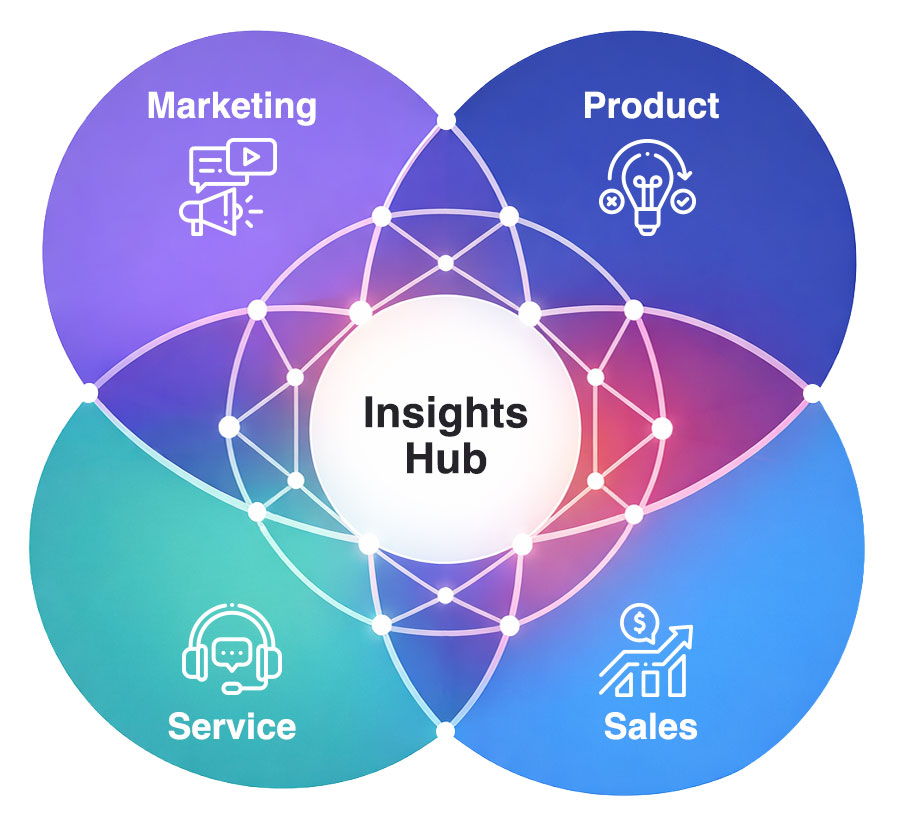
These are not questions a single team can answer. They require inputs from marketing, product, customer service, and sales. The answers live in the intersections between teams, not within one department’s dashboard.
The Challenge: Data is available. Insight still requires alignment.
Addressing these questions depends on shared understanding across functions. But that kind of alignment remains rare.
Marketing teams focus on campaign metrics. Product teams prioritize feature usage. Service leaders look at ticket resolution. Sales teams track pipeline health. Each team brings valuable perspective, but without collaboration, the full customer picture stays incomplete.
The cost of this fragmentation is substantial. Poor data quality resulting from siloed ownership costs companies 15 to 25 percent of their revenue. That is not just a technical issue. It is a strategic barrier to growth.
Translators and connectors will define the next era. The organizations that are pulling ahead are not just technically advanced. They have built connective tissue between teams. Their analytics leaders act as translators who help:
- Marketing interprets what product usage says about customer intent
- Service teams see how digital behavior predicts support needs
- Executives understand cross-functional data stories that inform strategy
The human role in analytics is shifting. Success no longer comes from delivering dashboards. It comes from facilitating shared insight and building consensus around what the data reveals.
Better collaboration becomes your competitive advantage in 2026. Customer journey analytics platforms have matured. Most of them work. The differentiator going forward is not technical capability but organizational agility.
To compete in 2026, companies need to:
- Build cross-functional data teams that can work from a shared understanding
- Standardize metrics and definitions to reduce confusion
- Invest in communication practices that drive alignment, not just reporting
AI is accelerating the questions. The ability to collaborate effectively is what will accelerate the answers.

Organizational Readiness Is the Real AI Challenge in 2026
The core challenge heading into 2026 is no longer technical. AI is delivering insights faster than most organizations can act on them. The platforms are ready. The real question is whether your organization is prepared to respond.
This gap between insight and action is not just an operational issue. It is a strategic risk. Teams that continue to operate in silos, with fragmented ownership and slow coordination, will miss the window of opportunity AI now provides. They will see important trends. They just won’t respond in time.
At the same time, this gap in AI capability and organizational readiness represents a clear opportunity. The organizations pulling ahead are treating this as a dual investment: in technology and in the structures that make that technology valuable.
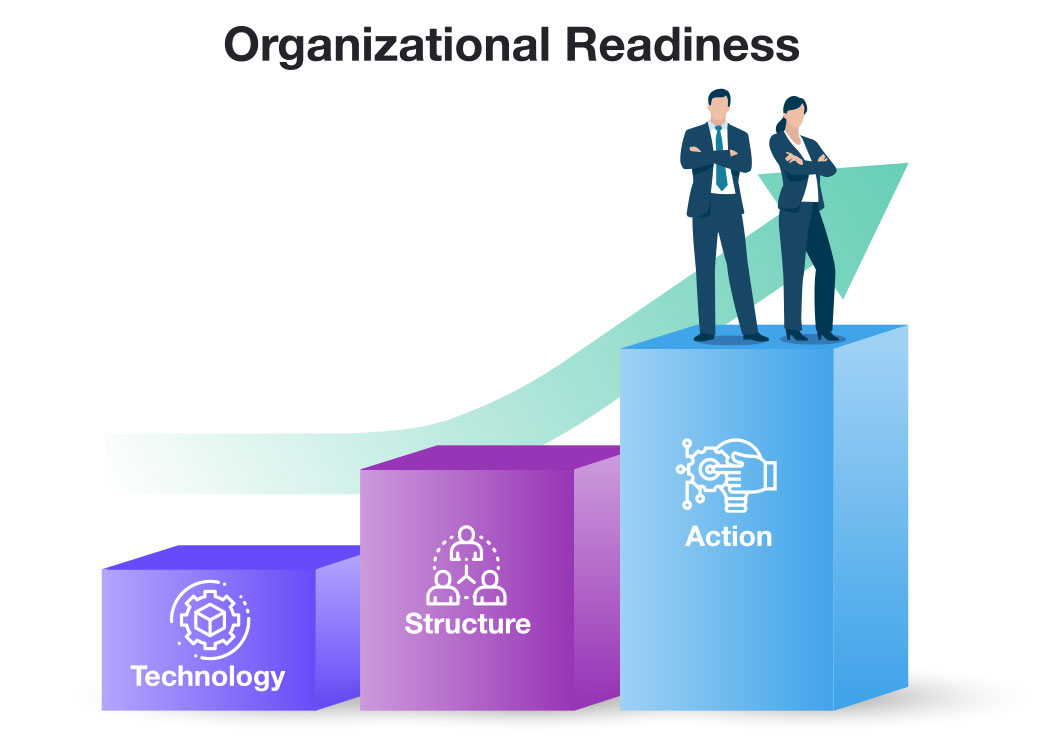
Here’s what that looks like in practice:
- Cross-functional data governance that defines clear ownership and access protocols
- Ongoing data literacy programs that help teams interpret insights with confidence
- Real-time response structures that translate alerts into coordinated action
Advanced AI was never really a competitive advantage on its own. What matters is whether your organization can turn AI-driven insights into decisions that move faster than the market.
At BlastX Consulting, we help enterprise teams close this readiness gap and get more from their analytics and insights. We guide marketing, product, and CX leaders to build the strategic foundation that turns analytics into action and action into outcomes.
If you’d like to dig deeper into this challenge of organizational readiness, reach out to me on LinkedIn, and let’s have a conversation.