

Most Customer Experience (CX) teams don’t have a customer data problem. They have a data trust problem. The numbers exist. What’s missing is confidence that everyone in the room is looking at the same version of the truth. This isn’t a rare complaint. According to Drexel University’s 2025 Data Integrity Trends and Insights report, 67 percent of organizations say they don’t completely trust their data for decision-making, a jump from 55 percent just a year earlier. Data trust is getting worse, not better, even as companies invest more in the tools meant to fix it.
That gap shows up in painfully familiar ways. A campaign report comes into someone’s inbox, and the first reply isn’t a question about strategy, it’s a question about the numbers themselves.
- Where did this figure come from?
- Does it match what sales is seeing?
- Is this the same definition of “conversion” the team used last quarter?
By the time those questions get answered, the meeting has moved on, and the decision gets made on instinct instead of evidence. Multiply that across every reporting cycle, and it’s easy to see why so many Customer Experience (CX) investments underperform. The tools were never the constraint. The trust was.
Bozzuto ran into this exact wall (see the 10x ROI client story). The multifamily real estate company had made real investment in marketing technology, but fragmented data sources made it hard to know what was actually working or where to spend next. Every team had a version of the truth, and none of them fully matched. What got Bozzuto out of it wasn’t a new dashboard or another platform bolted onto an already crowded stack. It was a system for trusting the data the team already had, built in three deliberate steps that any CX team can follow, regardless of industry or team size.

Start With One Source of Truth
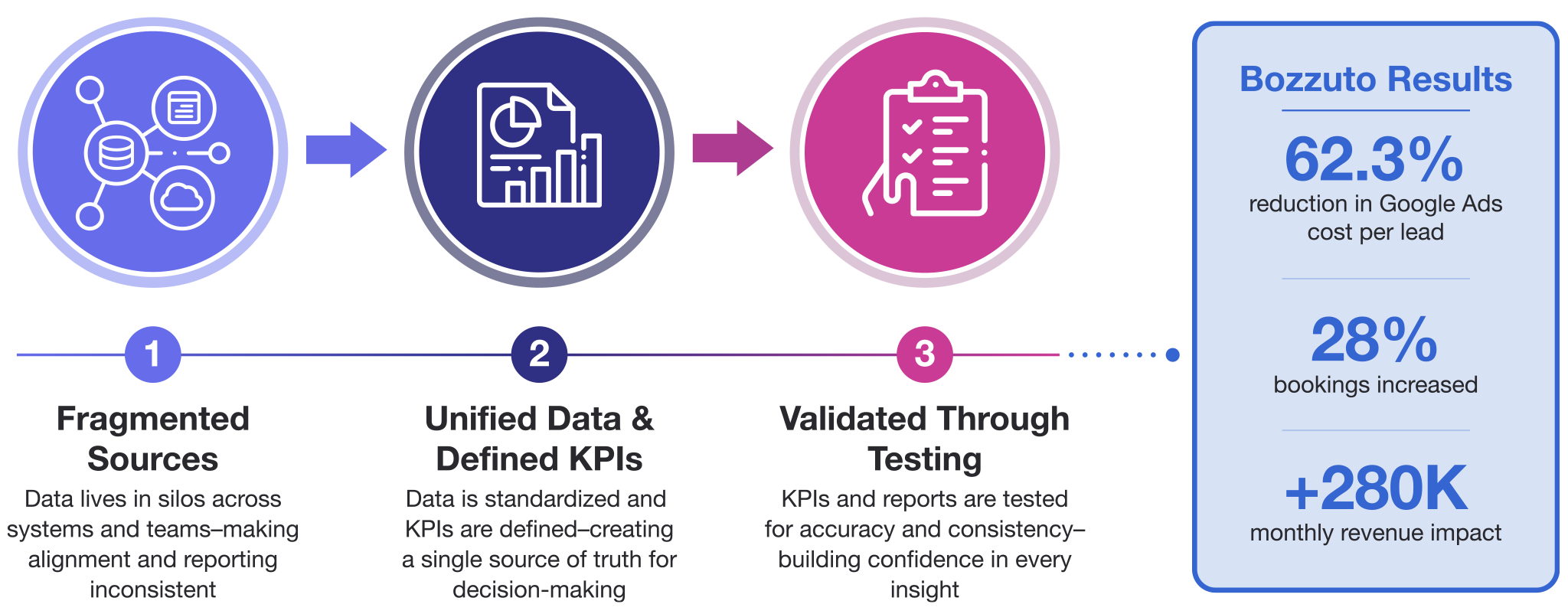
Before Bozzuto could act on its data, it had to agree on what the data said. The team partnered with BlastX Consulting to unify customer data rather than layer on another tool, bringing zero- and first-party data together through Tealium’s server-side capabilities. That single move mattered more than any individual campaign fix, because fragmented sources are what quietly erode data trust in the first place. When marketing sees one number, sales see another, and leadership sees a third, nobody’s wrong exactly, but nobody’s aligned either. Every conversation after that starts by rehashing whose numbers are right instead of deciding what to do next.
In our experience, this is where most CX data initiatives should begin, and almost never do. Teams jump straight to dashboards and reporting cadences before they’ve settled the more basic question: is there one place where the numbers actually agree with each other? Skip that step, and every downstream metric inherits the same distrust. No amount of visualization fixes a number nobody believes at the source.
Unifying data also does something less obvious but just as valuable: it exposes where the real gaps are. Bozzuto didn’t just consolidate reporting, it surfaced blind spots in how renters were actually moving through the funnel, information that had been sitting in disconnected systems the whole time. A single source of truth doesn’t just settle arguments. It reveals opportunities that fragmented data was hiding.
Design Around Real Behavior, Not Assumptions
Once the data was unified, Bozzuto still needed to know it was measuring the right things. BlastX Consulting led an Ideation Workshop to help the team reimagine the renter journey and define experience KPIs grounded in how renters actually behaved, not in what the team assumed they’d do. That work connected the CX strategy directly to the business case for a more privacy-conscious, scalable approach to marketing going forward.
This step is where data trust starts to compound. A metric someone can trace back to an observed behavior feels different from a metric that got inherited from last year’s plan or borrowed from an industry benchmark that never quite fit. When the team can point to the moment in the journey a number came from, people stop debating whether it’s accurate and start asking what to do about it. That shift, from defending the number to acting on it, is the real marker of a team that’s built data trust.
A metric someone can trace back to an observed behavior feels different from a metric that got inherited from last year’s plan.
It also changes how KPIs get set going forward. Once Bozzuto had metrics tied to observed renter behavior, priority-setting became a business conversation instead of a data-quality argument. Teams could disagree about strategy, which is healthy, instead of disagreeing about whether the underlying numbers were even real, which is exhausting and, over time, corrosive to a CX program’s credibility.

Validate With Small Tests Before You Scale
Bozzuto didn’t roll out its new approach everywhere at once. The team prioritized specific use cases, metro retargeting, property cross-targeting, web visitor stitching, and anonymous visitor remarketing, and tested them in select metro areas before expanding further. That sequencing did two things: it limited risk, and it gave the team hard proof that the data-driven approach worked before asking the rest of the organization to believe in it.
This is the step teams skip when they’re in a hurry, and it’s usually the one that costs them the most credibility later. A claim backed by a contained test that clearly worked is worth more than a companywide rollout nobody can fully explain. When something goes sideways in a small test, it’s a footnote. When it goes sideways after a full rollout, it’s a crisis, and it sets data trust back further than if the team had never tried at all.
Small tests also give the team something even more valuable than risk reduction: a shared, verifiable story. When Bozzuto’s test metro areas started outperforming, that result didn’t need to be argued for. It had already happened, in a contained, measurable way. That’s a very different starting point for a leadership conversation than a projection or a model.
The Payoff: What Data Trust Actually Buys You
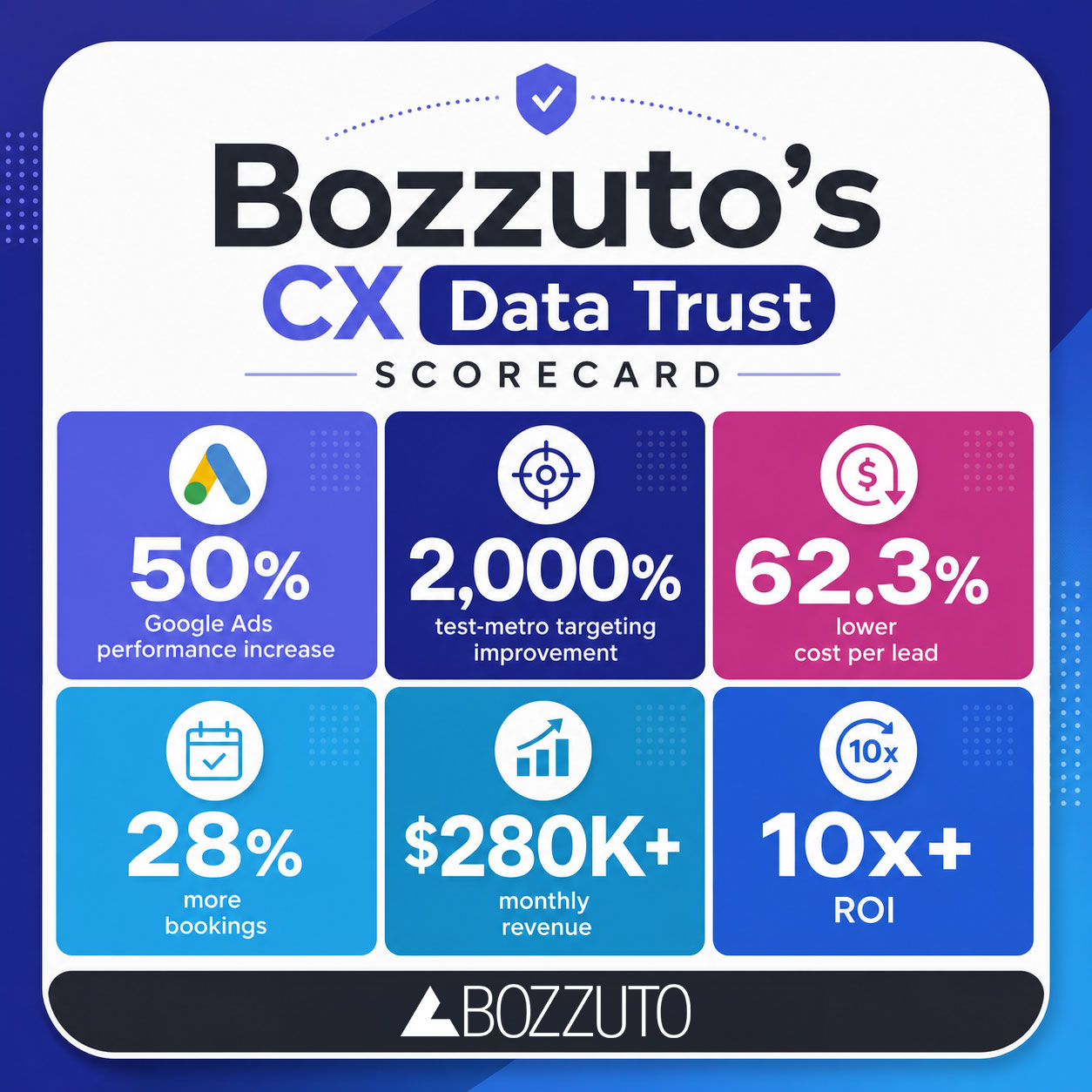
The results speak for themselves. Bozzuto saw Google Ads performance increase by 50 percent overall, with test metro areas seeing targeting performance improve by 2,000 percent. Cost per lead dropped by 62.3 percent. Bookings rose by 28 percent, and the engagement drove more than $280,000 in new monthly revenue, an estimated 10x+ return on Bozzuto’s CX investment.
None of that came from a bigger budget or a flashier tool. It came from a team that stopped arguing about whether the data was right and started acting on it with confidence. That’s the real return on building data trust: not just better numbers, but faster decisions, because nobody has to spend the first fifteen minutes of every meeting re-litigating the source.
It’s worth naming what this kind of result actually represents. A 10x+ ROI isn’t a one-time campaign win; it’s evidence that the underlying system works. Bozzuto now has a repeatable model, one it can apply across other markets and other paid media channels, because the foundation of trusted data and validated KPIs is already in place. That’s the difference between a good quarter and a durable capability.
What This Looks Like Applied to Your Team
The specifics will differ by industry, but the sequence holds. Start by identifying where your team’s numbers actually disagree, not where you assume they might. Ask three people to define the CX metric that matters most to your organization and see how many different answers come back. That gap is your starting point.
From there, resist the urge to add another tool before you’ve unified what you already have. Define your KPIs against real, observed behavior rather than industry benchmarks or last year’s targets. And when you’re ready to act on the new data, test it in a contained way before rolling it out everywhere. Each step builds the credibility the next one needs.
Where to Start Building Data Trust
If your team recognizes itself in that 67 percent, the fix isn’t more reporting. It’s a system:
- one source of truth,
- KPIs tied to real behavior,
- and small validated tests before you scale.
That’s the same path Bozzuto followed, and it’s available to any team willing to slow down at the start in order to move faster later.
Data distrust is a concerning problem that most companies face. You can learn more about combating data distrust and request a personalized data trust diagnostic to help you see where data is costing you. All without any commitment or cost.