Behavioral insights can be one of the most meaningful drivers of Customer Experience (CX) ROI. But the payoff comes only if teams access, use, and prove their impact.
Part one of this two-part series showed how behavioral data reveals the gap between the customer journey a company crafts and the one customers actually experience. Behavioral data shows where the experience breaks down, and each problem it identifies is an opportunity.
Unlocking CX ROI from behavioral data requires addressing the significant financial risk posed by unmeasured friction. Qualtrics XM Institute research estimates that poor customer experiences put $2.94 trillion in global spending at risk in 2026. Much of that risk never appears in a survey.
Even when feedback arrives, it often goes nowhere. Medallia’s 2026 State of Customer Experience Report found that 30 to 40 percent of departments take no action after receiving customer feedback. Capturing real-time behaviors, such as rage clicks and form abandonment, closes that gap by giving teams direct evidence of where the experience breaks down and what to fix.
The Correlation Between Behavioral Insights, UX Problems, and CX ROI
Behavioral analysis becomes more useful when we connect an interaction to the surrounding experience and the business outcome. Industry data explains why.
Consider: Baymard Institute reports the average e-commerce cart abandonment rate at 70.19 percent. Many carts are abandoned for reasons a business can’t or shouldn’t eliminate, such as browsing. The report also found that 17 percent of U.S. online shoppers abandoned an order because checkout was too long or complicated. That’s where behavioral evidence becomes actionable. Look at where abandonment occurs, the time between steps, error-prone fields, backtracking, repeated information, and whether failures cluster by device or browser.
The same logic applies throughout the customer journey. Repeated searches can indicate findability problems. Repeated form errors can reveal confusing requirements. Performance delays can interrupt intent. Repeated use of a valuable feature may signal faster value realization.
Not every behavior is a customer experience KPI. Behavioral insights are part of a chain of reasoning that supports desired business outcomes (e.g., engagement, retention, conversion).

Using Behavioral Insights to Improve Engagement, Retention, and Conversion
Behavioral insights can improve engagement, retention, and conversion, but only when you define those outcomes in terms of customer progress rather than surface activity. Here are a few examples of how this can play out:
Engagement: Measure Progress, Not Motion
A customer who reads three useful articles and requests a consultation is different from a customer who opens six pages because the first five didn’t answer the question. Behavioral insights help distinguish meaningful progression from effort disguised as engagement.
Retention: Find the Behaviors Around Value and Recurring Friction
Compare the journeys of customers who return with those who don’t. Look for early adoption, repeated errors, unresolved tasks, support escalations, or signs that customers reached value quickly.
Behavioral data can also drive personalization that keeps customers coming back, but getting it wrong drives them away. A 2025 Gartner survey found that personalization led to negative experiences for 53 percent of customers, and those customers were 44 percent less likely to buy from the brand again. Personalization works when it stems from understanding customers, not from collecting everything about them.
Behavioral data is valuable when it reduces effort or increases relevance. More data without added customer value is simply accumulation.
Conversion: Remove Obstacles Instead of Manipulating Clicks
Conversion optimization works best when we remove obstacles that prevent customers from completing an action they already intend to take: unnecessary fields, unclear requirements, latency, inconsistent content, or broken handoffs.
The best conversion gains often come as a byproduct of a clearer, more reliable customer journey.

What Behavioral Data Shows That Opinions Can’t
Customer experience work aims to drive better engagement, stronger retention, and higher conversion. Proving those gains is harder. “Customers seem happier” doesn’t hold up under scrutiny, and a lift no one can tie to a specific change can’t be defended or replicated.
Even a real gain isn’t enough on its own. A conversion lift that fades after the next release has no lasting impact, and without lasting impact, there’s no sustained CX ROI.
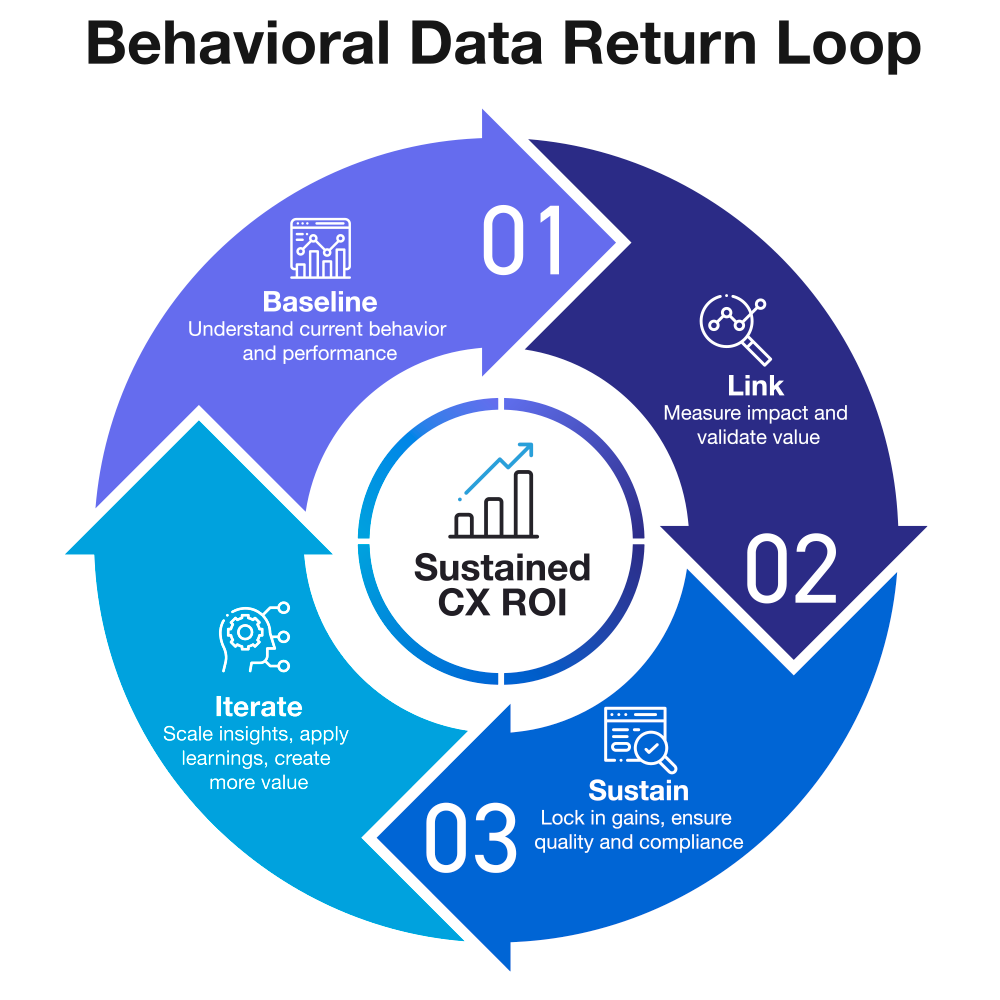
Behavioral data closes both gaps. It ties a specific change to a specific outcome, such as fewer drop-offs, more completed forms, or lower support demand, and it continues measuring after launch. That’s how a claim becomes evidence and a single gain becomes a sustained return. Four critical steps ensure this:
- Set a baseline. Before a change, behavioral data shows how customers move through the journey today: where they stall, repeat steps, or leave. Without a baseline, there’s nothing to prove.
- Link the change to the outcome. Path, event, and segment data show whether customers who reach the improved step convert, return, or contact support at different rates. That’s evidence that holds up to scrutiny.
- Stay the course. Journeys evolve as content, code, and campaigns change. Sustained behavioral monitoring detects when a fixed problem returns, so the impact lasts rather than quietly fading.
- Use iterative gains. Every proven change adds to the organization’s knowledge of its customers. The next improvement starts with evidence, not opinion, so it moves faster and carries less risk.
A single fix creates a single point of impact. A CX team that demonstrates its results and reuses what it learns builds a return that lasts and grows.
Behavioral insights are only as strong as the tracking behind them. A behavioral baseline built on incomplete tracking, or an outcome inflated by duplicate events, yields a CX ROI figure that won’t withstand scrutiny. Making that evidence trustworthy is operational work.
Behavioral Analytics Reliability Is Critical
Making behavioral data reliable comes down to tracking, logic, and integrations, all of which support accurate analysis and insights. Five practices keep it sound, so the behavioral data underlying the CX analytics helps shape the interventions that drive impact.
1. Track Every Step of the Journey
Measure every step of a priority journey, including interactions within single-page applications, dynamic content, and handoffs between platforms. Gaps in coverage don’t appear as errors. They appear as customer journeys that look shorter or simpler than they are, and as decisions built on missing steps.
2. Match Event Logic to Customer Behavior
An event should fire when the customer takes the action it represents. A form-start event that fires on page load counts every visitor as engaged and obscures where people actually drop off. Validate event logic against real behavior and retest after releases to keep conversion and engagement metrics honest.
3. Audit Every Integration
Enrichment tools, CDPs, and third-party platforms add value, but each can also introduce duplicate or conflicting events. Audit every new integration for what it sends, where it lands, and whether it changes existing counts.
4. Govern Tags and Campaign Classification
Naming conventions, campaign classification, and tag hygiene are routine tasks. They also keep reporting consistent as teams, vendors, and campaigns change. Clear ownership and documentation prevent small inconsistencies from compounding into distorted results.
5. Build Reporting on Shared Definitions
Stakeholders act on data they trust. That requires agreed-upon KPI definitions, reporting that reflects corrected tracking, and a customer experience team that examines the system behind each request. When the reporting holds up, the conversation shifts from closing tickets to deciding where to invest next.
None of these practices is glamorous. Together, they determine whether a CX ROI number withstands scrutiny from finance and leadership.

A Client Story: How Behavioral Insights Changed the ROI Conversation
One client engagement we supported illustrates how this works in practice.
The partnership began with reactive analytics support. As we handled individual requests, a pattern emerged: stakeholders didn’t trust parts of the data, certain parts of the digital journey weren’t measured accurately, and the technology the client already owned wasn’t delivering its full value.
Those problems didn’t appear in a single meeting or ticket. A content experience had incomplete tracking, including interactions within a single-page application. A “form start” event fired when the page loaded, not when someone interacted with the form. The form completion event fired twice, once on submission and again on the thank-you page. Later, an enrichment integration caused form starts to fire twice, too. Campaign classification and tag hygiene also needed work.
Each one looked like a minor implementation issue. Together, they made the numbers impossible to defend. In a typical week, reporting showed 200 form completions against roughly 100 actual submissions. Any ROI case built on that number would have been nearly double the truth, and finance would eventually notice.
We worked with the client to rebuild missing tracking, correct the form logic, remove duplicate events, clean up supporting configurations, and improve reporting. The week after we implemented the completion fix, the overcount dropped from about 100 extra completions to about 40, and it continued to decline as the remaining fixes took hold.
The bigger result was what the client did with numbers it could trust. The conversation shifted from “help us close this issue” to “tell us what we’re not seeing.” Reporting became a basis for planning CX investments, not something to explain away.
That shift came from looking at the system around each request, not just the request itself. Before closing any analytics ticket, review the event logic, the integrations feeding it, and the tag configuration around it. A fix that skips that check can break something else. Making that review routine kept the client’s data reliable, and each reliable fix made the next decision faster and easier to defend.
That’s how behavioral data builds CX ROI over time.

Making Behavioral Insights Your Strategic Advantage
The dashboard isn’t the outcome. Neither is the insight or the recommendation. The improved customer experience is the outcome that delivers CX ROI.
Behavioral insights are crucial for any company that wants greater impact from its digital customer experience optimization efforts. Why? Behavioral data shows where reality diverges from the experience we intended. Behavioral analytics sizes the problem. Research and feedback explain why. Proven, monitored changes show what actually improves it. A repeatable loop gives CX teams a way to keep directing resources toward what creates value and to build on what they learn. The result is better experiences and measurable business impact.
Not sure how to make your behavioral data and insights work for you? You’re not alone. That’s why we built the CX ROI Diagnostic. It identifies where tracking gaps, event logic, or integrations may be hurting your customer experience efforts and which fixes will deliver the most lasting impact. See if you qualify for a complimentary CX ROI Diagnostic.
-

Arturo Santiago-Rivera is a Senior Consultant in MarTech Engineering at BlastX Consulting, where he helps organizations build cleaner, more reliable digital data foundations. His work focuses on tracking architecture, data layers, implementation quality, tag governance, and the systems teams rely on to make confident marketing and customer experience decisions.
With a background spanning architecture, project management, information technology, software engineering, and analytics engineering, Arturo brings a structured, systems-focused approach to digital analytics. He bridges business requirements and technical implementation across platforms including Adobe Customer Journey Analytics, Adobe Experience Platform, Tealium, Google Tag Manager, Google Analytics 4, and Amplitude.
Arturo holds a Bachelor of Science in Computer Science and Software Engineering, an MBA, and a Master of Architecture. His credentials include Adobe Certified Expert for Customer Journey Analytics Developer, Tealium Product, Google Analytics, Google Ads Measurement, and Google Privacy for Agencies and Partners.