

AI-powered analytics tools are making data more accessible across organizations, but broader access does not guarantee better understanding. Without strong data literacy, teams risk misinterpreting AI-generated insights and making costly decisions based on flawed assumptions.
AI Analytics Opportunities and Business Risk
AI analytics is being positioned as a game changer for data-driven decision making. With natural language interfaces, automated dashboards, and generative AI agents, users can access insights instantly with no coding required. It’s a powerful promise: faster answers, broader access, and fewer dependencies on technical teams.
But in practice, many organizations face a growing problem. As AI makes data access easier, data literacy becomes more important, not less.
That may seem counterintuitive. If a tool can translate “show me our best-performing campaigns” into visual dashboards and smart summaries, then why do employees need to understand data concepts at all? Because what happens after the AI responds is where risk enters the equation.
Without a foundational understanding of data quality, context, and interpretation, teams can’t assess whether the AI was asked the right question, used complete data, or applied appropriate logic.
Take this real-world example: A marketing team uses AI analytics to find top-performing email campaigns. The tool ranks them by open rate, and the team quickly reallocates budget based on that data. Three months later, they realize the AI excluded mobile opens due to tracking limitations—misrepresenting performance and biasing strategy toward desktop-heavy segments that made up only 30 percent of their audience.
It’s not about mistrusting the tools—it’s about understanding how to use them wisely.
The issue wasn’t with the AI platform. It was a lack of data literacy to question the methodology and validate the assumptions behind the results.
This isn’t just a skills gap; it’s a business risk. When teams act on flawed or misunderstood data, the cost can be measured in millions, especially as AI adoption accelerates without guardrails.

AI Analytics Access Creates New Data Challenges
AI analytics platforms are reshaping how teams access and interpret business data. With natural language processing (NLP), users can ask plain-language questions and get instant answers. Machine learning (ML) algorithms surface insights automatically, and predictive analytics tools generate forecasts without requiring statistical expertise.
These tools represent real progress. Business users no longer need to wait on IT or write SQL to run queries. Marketers can test campaign hypotheses. Product teams can explore customer behavior. Access has expanded and that’s a win.
But broader access introduces hidden complexity.
When data interpretation was limited to technical analysts, decisions were filtered through statistical expertise. Analysts understood how to manage sample sizes, apply statistical significance, and distinguish correlation from causation. They knew when to question the data and how external variables—like seasonality or market conditions—could influence results.
AI analytics removes these gatekeepers and hands powerful tools to business users. But the tools don’t come with critical thinking built in. They can’t apply judgment, spot flawed assumptions, or compensate for missing context.
That’s where the risk lies: broad adoption without embedded data literacy.
AI Analytics Skills Gap Undermines Business Performance
The widening gap between AI adoption and data literacy is becoming a serious business risk. While investment in AI analytics accelerates across industries, data literacy initiatives are failing to keep up.
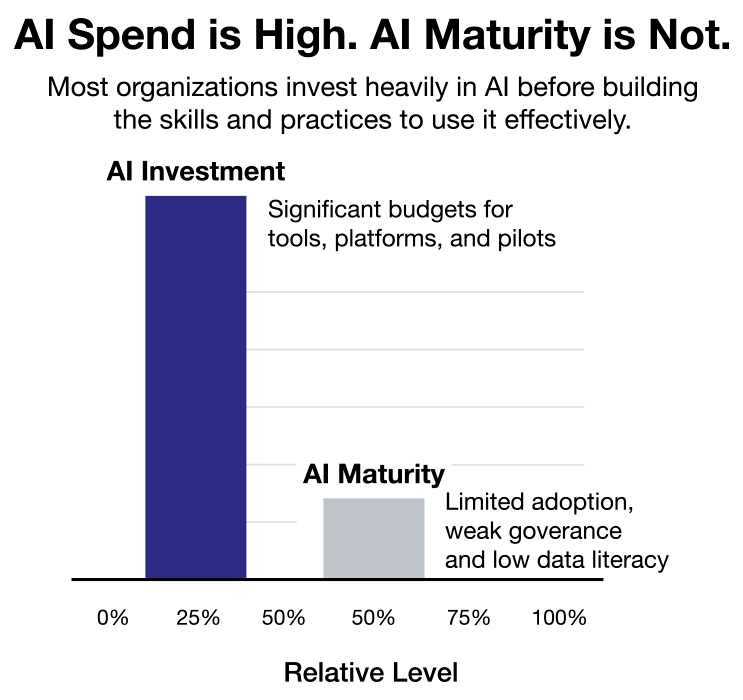
The numbers tell a clear story:
- Over half of business leaders report significant data literacy skill gaps in their organizations.
- A recent MIT study found that 95 percent of AI pilots have failed—often due to misaligned expectations or poor data interpretation.
- Only 1 percent of companies believe they’ve achieved AI maturity, despite heavy investment in AI tools and infrastructure (McKinsey State of AI, 2025).
These failures aren’t driven by bad technology. They’re driven by a lack of human capability to question, contextualize, and act on AI-generated insights.
What Data Literate Teams Do Differently
In every organization I’ve worked with, one consistent factor separates successful AI analytics initiatives from failed ones: the quality of the questions teams know to ask.
Teams with strong data literacy don’t passively accept AI-generated results. They challenge assumptions, evaluate sources, and apply critical thinking before making decisions. It’s not about mistrusting the tools—it’s about understanding how to use them wisely.
Here’s what sets high-performing teams apart:
- They interrogate data sources. When reviewing customer acquisition cost by channel, data-literate users ask about attribution models, cross-device limitations, and whether offline conversions were tracked. They know incomplete inputs lead to misleading outputs.
- They distinguish correlation from causation. AI is great at spotting patterns but can’t confirm causality. Skilled teams treat these patterns as hypotheses that require validation—not as final answers.
- They understand statistical context. Concepts like sample size, confidence intervals, and statistical significance guide their interpretation. These teams can separate signal from noise.
- They account for external factors. Market shifts, seasonal trends, competitive actions, and internal changes all influence metrics. Data-literate teams factor in these variables before drawing conclusions.
- They cross-validate insights. Rather than relying on a single AI-generated output, they compare results across time periods, data sources, and methods to ensure consistency.
These habits don’t require advanced degrees in data science—but they do require foundational literacy, structured thinking, and a culture that values inquiry over convenience.

How to Build Data Literacy with AI Analytics
Organizations can’t afford to treat AI adoption and data literacy as separate priorities. Long-term success depends on developing both, with coordinated implementation across teams and platforms.
Here is a three-part strategy to scale data literacy alongside AI analytics:
- Start with foundational concepts. Before rolling out AI tools widely, ensure teams understand the basics of data quality, statistical reasoning, and analytical thinking. They do not need to become experts in mathematics, but they do need the ability to evaluate evidence, challenge assumptions, and understand business context.
- Embed training into AI platform rollouts. Data literacy should not be a separate training track. Integrate it directly into the launch of AI analytics tools. When introducing natural language analytics, for example, include skill-building on query design, interpreting results, and validating insights.
- Connect technical and business teams. Create structured feedback loops between analysts and business users. This cross-functional collaboration helps teams apply analytical methods correctly and build the confidence to question AI outputs when needed.
Turning the AI Analytics Paradox into Advantage
The AI analytics paradox presents both a challenge and an opportunity. Organizations that address the growing gap between data access and data literacy will outperform those that rely on technology alone.
When AI tools are introduced without supporting skill development, the result is often a string of failed pilots and lost confidence. But when companies build analytical fluency alongside AI adoption, they create a foundation for long-term success.
This requires coordinated investment in both technology and people. Treat data literacy as a core capability that evolves with your analytics platforms. Build cross-functional collaboration between business users and analysts. Prioritize structured thinking, not just automation.
Success comes from knowing when to trust the AI and when to dig deeper. The organizations that strike this balance will ask better questions, make smarter decisions, and achieve measurable value from their AI investments.
At BlastX Consulting, we help organizations close this gap with targeted data literacy programs that align with AI analytics strategies. Our approach ensures that technology delivers value while your teams gain the skills to use it effectively.
Let’s talk about a data literacy program for your organization. Let’s turn this paradox into your organization’s competitive advantage.